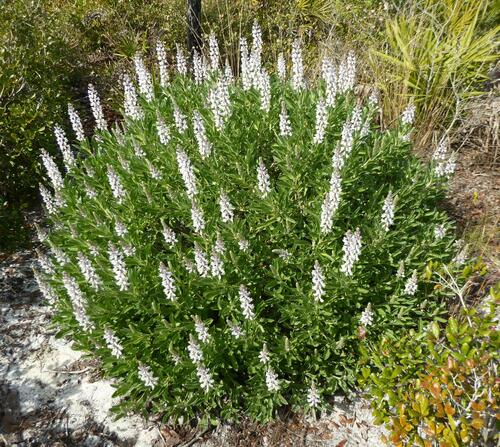


Unifoliolate Floridian Lupine Clade
lupinus cumulicola
The Unifoliolate Floridian Lupine, scientifically known as Lupinus cumulicola, is a stunning, highly specialized perennial herb endemic to the rapidly disappearing sand pine scrubs of peninsular Florida. Adapting beautifully to the harsh, nutrient-poor sandy soils of ancient dune ridges, this plant is a vital pioneer species that helps stabilize loose sands. Unlike many other lupines with palmate leaves, this unique clade is characterized by its simple, unifoliolate leaves that shimmer with a silvery-green sheen. During the spring, it transforms the dry scrub landscape with majestic upright spikes of sky-blue to deep violet flowers. Historically overlooked, it plays a key ecological role in its restricted habitat by enriching the soil through nitrogen fixation and supporting a delicate web of native pollinators.
Hábitat: Found in open, sun-drenched sand pine scrub, oak scrub, and coastal sandhills on well-drained, nutrient-poor white sands.
This herbaceous plant typically grows in rounded clumps reaching 30 to 100 centimeters in height. Its most identifying feature is its simple, unifoliolate leaves which are ovate to elliptic, covered in dense, silky, pressed hairs that give them a distinctive silvery or dusty-green appearance. The showy, pea-like flowers are clustered on long, terminal spikes, displaying shades of pale sky-blue, lavender, or deep violet, often featuring a white or yellow spot on the banner petal that fades to reddish-purple after pollination. Following the bloom, it produces fuzzy, oblong seed pods containing several hard, mottled seeds.
Categoría
PlantasRareza
Common
Peligro
1/5 · Muy bajo
Snaps
¡Sé la primera persona en hacer un snap!
Its seeds have a tough coat that often requires the heat of a natural wildfire or physical abrasion to trigger germination.
The plant's silvery hairs function like miniature mirrors, reflecting harsh UV rays and giving the entire plant a ghostly, glowing appearance under direct sunlight.
Unlike most lupine species which have palmate leaves resembling fingers on a hand, this unique Florida clade features simple, single leaves.
The dense coating of fine, reflective hairs on its leaves protects the plant from intense solar radiation and reduces moisture loss through transpiration.
It forms a symbiotic relationship with subterranean bacteria in its root nodules, allowing it to convert atmospheric nitrogen into a usable nutrient form in sterile soils.
A robust, deep taproot system anchors the plant firmly in shifting sand dunes while reaching deep water reserves inaccessible to shallow-rooted competitors.
As a photoautotrophic plant, it produces its own energy by capturing sunlight through photosynthesis, utilizing water, carbon dioxide, and soil minerals.
Bombus pennsylvanicus
Provides essential nectar and pollen, relying on the bee for cross-pollination.
Callophrys irus
Acts as a crucial larval host plant where caterpillars feed on the leaves and flower buds.
Bradyrhizobium japonicum
Hosts symbiotic bacteria in its roots that fix atmospheric nitrogen to enrich the soil.
Aún no hay insignias de rasgos asignadas a este objeto.
Las colecciones para este objeto aparecerán aquí a medida que se añadan más temas.
Peligro
1/5 · Muy bajo
Todavía no hay notas especiales de seguridad.
La forma más fácil de identificar a Unifoliolate Floridian Lupine Clade es usar la aplicación de identificación de naturaleza Snappit.
30-100 cm
0.05-0.3 kg
2-5 años
As a photoautotrophic plant, it produces its own energy by capturing sunlight through photosynthesis, utilizing water, carbon dioxide, and soil minerals.
Found in open, sun-drenched sand pine scrub, oak scrub, and coastal sandhills on well-drained, nutrient-poor white sands.
Acércate para separar los grupos y explorar dónde se ha fotografiado este objeto.
Los snaps recientes aparecerán aquí a medida que se añadan nuevas observaciones.
















