Utah Honeysuckle
Lonicera utahensis
Utah Honeysuckle is a sweet-smelling shrub that grows in the wild. It has beautiful yellow and orange flowers that attract butterflies and hummingbirds, making it a lovely sight in nature.
Hábitat: Mountain regions
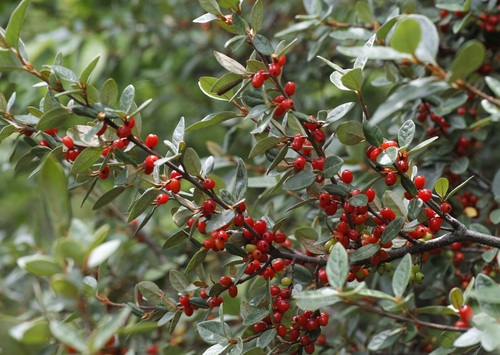
The Utah Honeysuckle is a medium-sized shrub with opposite, oval leaves and pairs of delicate, yellowish-white to pale yellow trumpet-shaped flowers. Its striking red to orange berries develop in autumn, providing a vibrant contrast to its green foliage.
Categoría
PlantasRareza
Common
Peligro
1/5 · Muy bajo
Snaps
¡Sé la primera persona en hacer un snap!
Despite its sweet-smelling flowers, the berries have a surprisingly bitter taste to humans!
Indigenous peoples once used its tough, hollow stems for small, intricate craft projects.
Its bell-shaped flowers grow in distinct pairs, earning it the nickname 'twinflower' honeysuckle!
This hardy shrub is a favorite snack for deer and elk, especially during harsh winters!
Utah Honeysuckle's tubular flowers produce sweet nectar to attract hummingbirds and bees for efficient pollination.
This plant has a strong root system helping it survive dry, rocky soils by finding and storing water.
Its bright red berries are eaten by birds, which then scatter the seeds, helping the plant spread.
.jpg&width=800)
Selasphorus rufus
Sips nectar from the tubular flowers.
Bombus occidentalis
Collects nectar and pollen, aiding reproduction.
Odocoileus hemionus
Browses on its leaves and twigs, especially in winter.
Turdus migratorius
Consumes the red berries, helping to disperse seeds.
Las plantas aromáticas producen y emiten compuestos orgánicos volátiles fragantes, a menudo como defensa o para atraer a los polinizadores.
Las plantas caducifolias pierden periódicamente todas sus hojas, por lo general durante el otoño o las estaciones secas.
Las plantas con flores son cualquier planta que produce flores como parte de su ciclo reproductivo.
Un arbusto es una planta leñosa más pequeña que un árbol, típicamente con múltiples tallos que se ramifican desde o cerca del suelo.

Las flores fragantes emiten un aroma agradable, a menudo para atraer polinizadores o como defensa.

Las plantas frutales producen frutos, que son los ovarios maduros de las plantas con flores que contienen semillas.

Las plantas comestibles son aquellas partes de una planta que se consideran seguras para el consumo humano.

Describe plantas que son particularmente atractivas y beneficiosas para una amplia variedad de organismos polinizadores.

Este rasgo de hábitat identifica a las especies que se encuentran en regiones montañosas, caracterizadas por su gran altitud, pendientes pronunciadas y zonas climáticas variables.
Todavía no hay alias listados.
Peligro
1/5 · Muy bajo
Always look but don't touch the berries, as they may not be safe to eat.
100-300 cm
100-200 cm
1-2 cm
Spring-early summer
No
Leve
Perenne
Insectos
Acércate para separar los grupos y explorar dónde se ha fotografiado este objeto.
Los snaps recientes aparecerán aquí a medida que se añadan nuevas observaciones.

British Columbia, CA
Puedes ver Shinyleaf Meadowsweet, Northern Checkerspot y Fireweed.
Ver guía →
British Columbia, CA
Puedes ver Canadian Buffalo-Berry, Oregon Boxwood y Pacific Trillium.
Ver guía →

British Columbia, CA
Puedes ver Western Columbine, Mountain Lady's-Slipper y Thimbleberry.
Ver guía →
British Columbia, CA
Puedes ver Common Beargrass, White-Flowered Rhododendron y Glacier Lily.
Ver guía →