

Veiled Polypore
cryptoporus volvatus
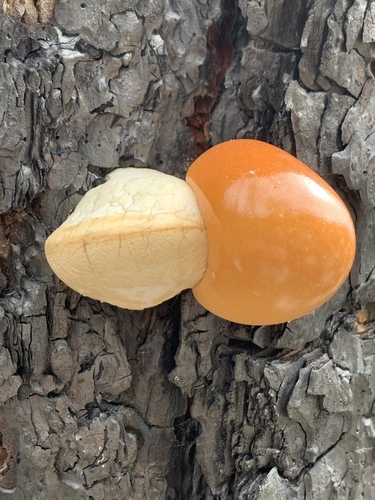
The Veiled Polypore (Cryptoporus volvatus) is a highly unique and fascinating wood-decay fungus found primarily on dead or dying coniferous trees. Unlike typical bracket fungi that release their spores directly into the wind, this species has co-evolved a brilliant survival strategy involving a protective pouch. It forms small, hollow, egg-like fruiting bodies that cling to tree trunks, sealing its spore-bearing surface behind a tough, parchment-like membrane. This physical barrier creates an ideal microclimate, shielding the spores from drying out. To overcome the challenge of wind-dispersal, the Veiled Polypore relies on forest insects. Boring beetles and other forest arthropods are attracted by the sweet, attractive aroma emitted by the fungus. They chew small holes in the protective veil, enter the moist chamber, and inadvertently coat themselves in spores. As these insects move to other trees, they act as primary vectors, dispersing the fungus across the forest ecosystem.
Hábitat: Found on the bark of recently dead or dying coniferous trees, especially pines and firs, in temperate and boreal forests.
This distinctive fungus is easily recognized by its small, rounded, hoof-like or spherical fruiting bodies that measure 1.5 to 5 centimeters across. They are typically cream-colored, pale yellow, or yellowish-orange, with a smooth, slightly varnished top surface that darkens with age. The defining characteristic is the smooth, leather-like white veil or membrane covering the entire underside. A small, natural hole eventually develops near the base of this veil, allowing insects access to the hidden, chocolate-brown pore surface within.
Categoría
HongosRareza
Common
Peligro
1/5 · Muy bajo
Snaps
¡Sé la primera persona en hacer un snap!
It is often referred to as the 'pouch fungus' because the protective membrane gives it the appearance of a small, hollow leather pouch clinging to the wood.
The interior of a mature veiled polypore is a microscopic ecosystem of its own, often hosting dozens of species of mites, beetles, and thrips.
While wind disperses billions of spores for most mushrooms, this clever fungus relies almost 100% on hitchhiking insects for reproduction.
Utilizes a thick, parchment-like membrane that completely covers the spore-bearing surface to protect it from drying winds and moisture loss.
Emits highly targeted chemical compounds that mimic tree resins and pheromones to attract bark beetles, which then distribute its spores.
Produces specialized enzymes that rapidly break down cellulose and lignin in dead sapwood, playing a vital role in forest nutrient cycling.
A saprotrophic decomposer that digests wood components, primarily cellulose and lignin, from dead and dying coniferous trees.
Dendroctonus ponderosae
The fungus colonizes trees killed by this insect, and the emerging beetles carry fungal spores to newly targeted host trees.
Pinus ponderosa
Acts as a primary decomposer of the dead wood of this host coniferous tree.
Bolitotherus cornutus
Larvae of this beetle inhabit the inner spore chamber, feeding on the spores and helping to disperse them.
Aún no hay insignias de rasgos asignadas a este objeto.
Todavía no hay alias listados.
Las colecciones para este objeto aparecerán aquí a medida que se añadan más temas.
Peligro
1/5 · Muy bajo
Todavía no hay notas especiales de seguridad.
La forma más fácil de identificar a Veiled Polypore es usar la aplicación de identificación de naturaleza Snappit.
1-5 cm
0.005-0.03 kg
1 años
A saprotrophic decomposer that digests wood components, primarily cellulose and lignin, from dead and dying coniferous trees.
Found on the bark of recently dead or dying coniferous trees, especially pines and firs, in temperate and boreal forests.
Foraging
Acércate para separar los grupos y explorar dónde se ha fotografiado este objeto.
Los snaps recientes aparecerán aquí a medida que se añadan nuevas observaciones.