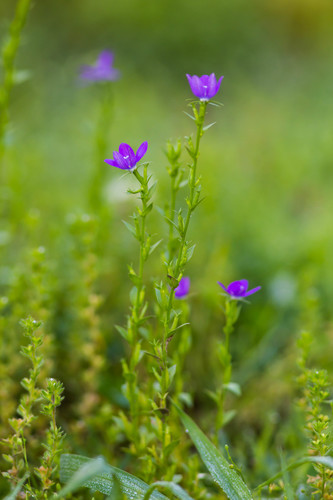


Venus'S Looking-Glass
triodanis biflora
Venus's Looking-Glass (Triodanis biflora) is a charming, slender annual wildflower native to the Americas. Commonly found gracing roadsides, fallow fields, and rocky glades, this plant is best known for its bright, star-shaped purple flowers. Its resilience allows it to thrive in nutrient-poor and highly disturbed soils where other plants struggle, making it a pioneer species of sorts in post-clearing landscapes. What makes this species particularly fascinating is its reproductive strategy. It employs a mixed-mating system utilizing both open, insect-pollinated flowers and closed, self-pollinating flowers. This dual mechanism ensures that the plant can produce seeds even in years when pollinator populations are low, securing its lineage across diverse and unpredictable environments.
Hábitat: Typically found in disturbed sites, open fields, roadsides, and glades with sandy or rocky soil.
This slender, erect herb grows between 10 to 45 cm tall, featuring simple, mostly unbranched stems covered in fine hairs. The leaves are small, sessile, and clasping, with an ovate to lanceolate shape. The flowers are arranged along the upper stem; the lower flowers are small, green, and bud-like (never opening), while the upper flowers burst into bright violet-blue stars, each with five pointed petals and a white center, measuring about 1 to 1.5 cm across.
Categoría
PlantasRareza
Common
Peligro
1/5 · Muy bajo
Snaps
¡Sé la primera persona en hacer un snap!
It produces two distinct types of flowers: the lower ones never open and self-pollinate in secret, a process known as cleistogamy.
The common name 'Venus's Looking-Glass' comes from an old European folklore tale that the plant resembled a mirror dropped by Venus, the Roman goddess of love.
The seeds are tiny and dust-like, easily dispersed by wind or passing animals through small pores in the sides of its dry seed capsules.
Produces self-pollinating flowers near the base that never open, ensuring seed production even in the total absence of insect pollinators.
Releases its minuscule seeds through small pores in the sides of the dry seed capsules, letting the wind distribute them gradually.
Thrives in dry, compacted, or nutrient-poor sandy soils, outcompeting less hardy species in degraded habitats.
As a photosynthetic plant, it manufactures its own organic compounds using sunlight, carbon dioxide, water, and soil minerals.
Lasioglossum vierecki
Feeds on pollen and nectar while acting as a key pollinator for chasmogamous flowers.
Odocoileus virginianus
Occasionally browses on the foliage of Venus's Looking-Glass.
Taraxacum officinale
Competes for space, light, and nutrients in open, disturbed grasslands.
Aún no hay insignias de rasgos asignadas a este objeto.
Todavía no hay alias listados.
Las colecciones para este objeto aparecerán aquí a medida que se añadan más temas.
Peligro
1/5 · Muy bajo
Todavía no hay notas especiales de seguridad.
La forma más fácil de identificar a Venus'S Looking-Glass es usar la aplicación de identificación de naturaleza Snappit.
10-45 cm
1 años
As a photosynthetic plant, it manufactures its own organic compounds using sunlight, carbon dioxide, water, and soil minerals.
Typically found in disturbed sites, open fields, roadsides, and glades with sandy or rocky soil.
Acércate para separar los grupos y explorar dónde se ha fotografiado este objeto.
Los snaps recientes aparecerán aquí a medida que se añadan nuevas observaciones.








_Viola_arvensis_-_White_flower.jpg&width=800)





