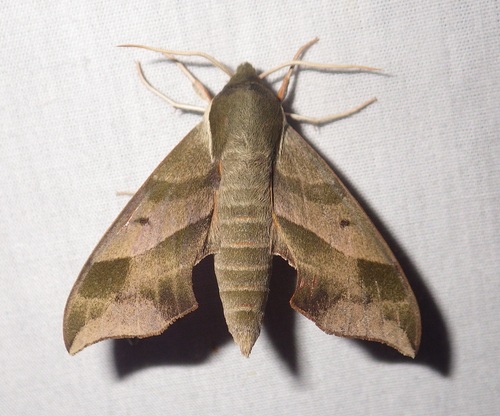


Virginia Creeper Sphinx
darapsa myron
The Virginia Creeper Sphinx (Darapsa myron) is a fascinating and relatively common species of hawkmoth native to North America. Often overlooked despite its beautifully patterned wings, it plays a quiet but important role in its local ecosystems as both an herbivore and a pollinator. As caterpillars, they are voracious eaters of vine foliage, while the adults are capable of swift, agile flight. Their presence in a garden or woodland is a wonderful indicator of a healthy, native plant population.
Hábitat: Found primarily in deciduous forests, woodland edges, and suburban gardens where host plants like wild grape and Virginia creeper are abundant.
Adult moths feature distinctive forewings that blend shades of olive green, brownish-green, and tan, with darker bands across the middle, while their hindwings are a contrasting warm orange or dull copper. They possess a robust, torpedo-shaped body typical of hawkmoths, with a wingspan ranging from 4 to 7 centimeters. The caterpillars are equally striking, appearing in either bright green or reddish-brown morphs, adorned with pale diagonal side stripes and a prominent, harmless horn on their posterior end.
Categoría
InsectosRareza
Common
Peligro
1/5 · Muy bajo
Snaps
¡Sé la primera persona en hacer un snap!
In the southern parts of its range, this moth can produce up to three generations per year, while northern populations only have enough warm weather to produce one.
Like many hawkmoths, this species can hover in mid-air while feeding, which often leads people to mistakenly identify them as small hummingbirds at dusk.
The caterpillars are frequently targeted by tiny parasitoid wasps, which spin dozens of white, cottony cocoons on the caterpillar's back after feeding on it from the inside out.
When resting on a branch, the Virginia Creeper Sphinx holds its wings in a swept-back, tent-like shape, making it look almost indistinguishable from a dead leaf.
Capable of hovering in mid-air to drink nectar from deep flowers, moving with a humming sound similar to a tiny bird.
When at rest, the adult moth holds its mottled olive and brown wings in a swept-back, tent-like posture, perfectly mimicking a curled dead leaf.
When disturbed, the caterpillars will violently thrash their front ends back and forth to startle and deter potential predators.
The caterpillars consume large amounts of leaf tissue, while adult moths primarily drink nectar from flowering plants.
Diferencias por edad: Caterpillars exclusively chew foliage, whereas adult moths transition to a liquid diet, drinking nectar through a long, specialized proboscis.
Parthenocissus quinquefolia
Serves as the primary host plant for the caterpillars to feed on.
Vitis riparia
Provides an alternative, highly favored food source for the developing larvae.
Cotesia congregata
A tiny parasitoid that lays its eggs inside the caterpillar, eventually spinning white cocoons on its back.
Eptesicus fuscus
A nocturnal predator that frequently catches and consumes the adult moths mid-flight.
Aún no hay insignias de rasgos asignadas a este objeto.
Todavía no hay alias listados.
Las colecciones para este objeto aparecerán aquí a medida que se añadan más temas.
Peligro
1/5 · Muy bajo
Todavía no hay notas especiales de seguridad.
La forma más fácil de identificar a Virginia Creeper Sphinx es usar la aplicación de identificación de naturaleza Snappit.
2-4 cm
4-7 cm
0.001-0.003 kg
hasta 1 años
25 km/h
The caterpillars consume large amounts of leaf tissue, while adult moths primarily drink nectar from flowering plants.
Found primarily in deciduous forests, woodland edges, and suburban gardens where host plants like wild grape and Virginia creeper are abundant.
Acércate para separar los grupos y explorar dónde se ha fotografiado este objeto.
Los snaps recientes aparecerán aquí a medida que se añadan nuevas observaciones.

Maryland, US
Puedes ver Rana Toro Americana, Sapo De Fowler y North American Luna Moth.
Ver guía →

Ohio, US
Puedes ver Libélula De Cola Blanca y Caballito Del Diablo Frágil.
Ver guía →

Alabama, US
Puedes ver Carpintero Cabecirrojo y Hardwood Stump Borer.
Ver guía →









%2C_Hohlenwiesbach%2C_Rocherath%2C_Ostbelgien_(19474316013).jpg&width=800)







