

Walking Fern
asplenium rhizophyllum
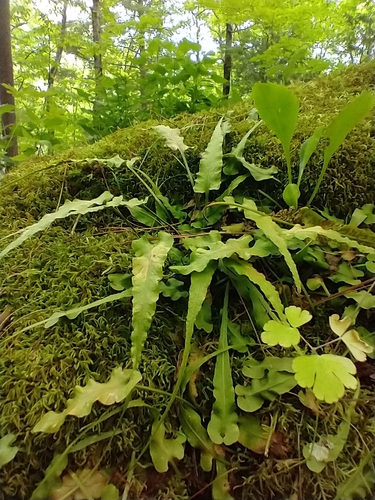
The Walking Fern (Asplenium rhizophyllum) is a remarkable evergreen fern native to eastern North America. Unlike most ferns that spread primarily via spores, this species has earned its charismatic name through an unusual method of vegetative reproduction. Its long, arching fronds taper to extremely fine, thread-like tips. When these tips touch a moist, mossy surface, they can develop roots and grow into entirely new, independent daughter plants. Over time, a single parent fern can "walk" across rock faces, creating dense, interconnected carpets of cloned offspring. Finding a patch of walking ferns clinging to a shady limestone cliff feels like discovering a hidden, miniature forest world. It represents a beautiful adaptation to life on steep, vertical rock surfaces where soil is scarce and traditional spore colonization can be challenging, making it a highly prized sighting for hikers and botanists alike.
Hábitat: Found on shaded, moist, mossy limestone or dolomite rock faces within rich, mature deciduous forests.
This small fern features simple, undivided, lance-shaped fronds that are leathery, evergreen, and dark green. The fronds have an asymmetrical, heart-shaped base and taper dramatically to a long, narrow, pointed tip, typically growing in spreading rosettes between 5 and 30 centimeters in length. On the undersides of mature fronds, you can find brown, linear spore cases (sori) scattered irregularly along the veins.
Categoría
PlantasRareza
Common
Peligro
1/5 · Muy bajo
Snaps
¡Sé la primera persona en hacer un snap!
Because it requires highly specific alkaline conditions, the presence of Walking Fern is a reliable biological indicator of limestone or dolomite bedrock.
Its common name is a literal description of its movement, as it can propagate across a cliff face at a rate of several inches per generation.
The Walking Fern is a parent species to several naturally occurring sterile and fertile hybrid ferns when it crosses with other Asplenium species.
The fern's long, tapered frond tips develop roots and buds upon contact with moist substrate, allowing it to vegetatively clone itself and physically step across rock surfaces.
It is specially adapted to thrive on alkaline limestone and dolomite rocks, extracting essential minerals directly from calcium-rich geological formations.
Its leathery, dark green fronds persist through the freezing winter months, allowing the plant to photosynthesize immediately during early spring.
As a photoautotrophic plant, the Walking Fern synthesizes its own food using sunlight, carbon dioxide, and water, supplemented by minerals absorbed from calcareous rocks.
Anomodon attenuatus
The moss provides a moist, soil-retaining microhabitat on limestone cliffs that facilitates the walking fern's tip-rooting.
Odocoileus virginianus
Occasionally grazes on the evergreen fronds during winter when other food sources are scarce.
Asplenium trichomanes
Shares the same shaded, alkaline rocky niches and competes for space and moisture.
Aún no hay insignias de rasgos asignadas a este objeto.
Todavía no hay alias listados.
Las colecciones para este objeto aparecerán aquí a medida que se añadan más temas.
Peligro
1/5 · Muy bajo
Todavía no hay notas especiales de seguridad.
La forma más fácil de identificar a Walking Fern es usar la aplicación de identificación de naturaleza Snappit.
5-30 cm
0.01-0.05 kg
5-15 años
As a photoautotrophic plant, the Walking Fern synthesizes its own food using sunlight, carbon dioxide, and water, supplemented by minerals absorbed from calcareous rocks.
Found on shaded, moist, mossy limestone or dolomite rock faces within rich, mature deciduous forests.
Acércate para separar los grupos y explorar dónde se ha fotografiado este objeto.
Los snaps recientes aparecerán aquí a medida que se añadan nuevas observaciones.