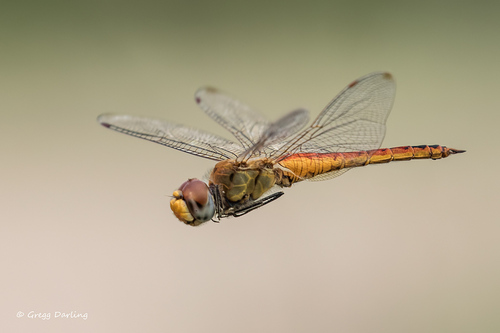


Wandering Glider
pantala flavescens
The Wandering Glider, also known as the Globe Skimmer, is arguably the world's most widespread dragonfly and a true marvel of the insect world. Famous for undertaking the longest known insect migration, this remarkable species travels thousands of kilometers across open oceans, following seasonal weather fronts and monsoon rains. By riding high-altitude trade winds and thermals, they effortlessly cross continents, linking ecosystems from India to East Africa in a multi-generational journey. Because they breed in temporary rain pools, their entire life cycle is closely tied to global weather patterns, making them a beautiful and visible indicator of seasonal changes.
Hábitat: Found globally in almost every tropical and temperate region, typically soaring over open landscapes, coastal areas, and near temporary freshwater pools or seasonal rain puddles.
This medium-sized dragonfly measures roughly 4 to 5 centimeters in length and features a distinctive yellowish-golden to pale orange abdomen, often marked with a dark dorsal stripe. Its large, reddish-brown eyes wrap around to meet at the top of its head, granting an immense field of vision. The most defining visual characteristic is its exceptionally broad, transparent hindwings, which provide a massive surface area that allows the insect to glide effortlessly on air currents rather than relying on constant, energy-draining flapping.
Categoría
InsectosRareza
Common
Peligro
1/5 · Muy bajo
Snaps
¡Sé la primera persona en hacer un snap!
Because they rely on temporary rain pools to breed, they deliberately follow global monsoon systems and rain fronts across continents.
The Wandering Glider holds the record for the longest insect migration in the world, completing a multi-generational round trip that can exceed 18,000 kilometers.
Their wing surface area is so large compared to their body weight that they can effortlessly catch updrafts and ride them for hours without flapping.
They were the first insect species recorded repopulating the Bikini Atoll after the devastating atomic bomb tests.
Capable of flying thousands of kilometers across open oceans by riding the high-altitude winds of the Intertropical Convergence Zone.
Nymphs can mature in as little as 38 to 65 days, allowing them to successfully grow in temporary rain pools before the water evaporates.
Possesses extraordinarily broad hindwings that function like natural gliders, enabling them to soar on thermal updrafts for hours with minimal energy expenditure.
An agile aerial predator that catches and consumes smaller flying insects entirely on the wing.
Diferencias por edad: Aquatic nymphs are voracious predators of mosquito larvae and small water invertebrates, while adults hunt exclusively airborne insects.
Aedes aegypti
Hunts and consumes significant quantities of disease-carrying mosquitoes.
Falco amurensis
Preyed upon by migratory falcons as a crucial food source during the falcons' own ocean crossing.
Anax junius
Competes for airborne prey in overlapping North American ranges.
Aún no hay insignias de rasgos asignadas a este objeto.
Todavía no hay alias listados.
Las colecciones para este objeto aparecerán aquí a medida que se añadan más temas.
Peligro
1/5 · Muy bajo
Todavía no hay notas especiales de seguridad.
La forma más fácil de identificar a Wandering Glider es usar la aplicación de identificación de naturaleza Snappit.
4-5 cm
7-8 cm
0.0003-0.0005 kg
0-1 años
30 km/h
An agile aerial predator that catches and consumes smaller flying insects entirely on the wing.
Found globally in almost every tropical and temperate region, typically soaring over open landscapes, coastal areas, and near temporary freshwater pools or seasonal rain puddles.
Acércate para separar los grupos y explorar dónde se ha fotografiado este objeto.
Los snaps recientes aparecerán aquí a medida que se añadan nuevas observaciones.









_Figure_1_b.jpeg&width=800)





