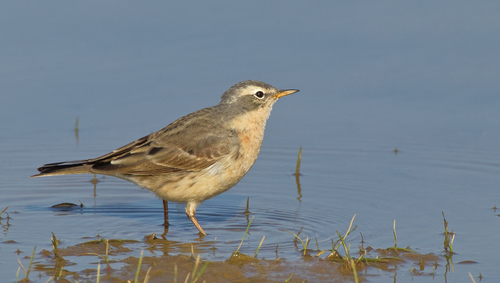


Water Pipit
anthus spinoletta
The Water Pipit (Anthus spinoletta) is a small, agile passerine bird celebrated for its adaptability to harsh, high-altitude environments. Often encountered in mountainous regions during summer, it descends to lower elevations and coastal areas in winter. This species is a master of camouflage, blending seamlessly with its rocky and grassy surroundings, making it a rewarding find for nature enthusiasts. Its distinctive call and energetic foraging style are key characteristics that define this hardy avian traveler. It's a prime example of an animal perfectly suited to its niche, navigating seasonal changes through extensive migrations.
Hábitat: This species primarily inhabits high-altitude alpine meadows, rocky slopes, and moist tundra during the breeding season, moving to lower pastures, wet fields, and coastal mudflats in winter.
The Water Pipit is a slender bird, typically measuring 15-17 cm in length with a wingspan of 26-30 cm. Its upperparts are a dull brownish-grey, often finely streaked, providing excellent camouflage against rocky or grassy backdrops. The underparts are usually buffish to whitish, with prominent dark streaks on the breast and flanks. During the breeding season, some individuals may display a pinkish wash on the breast. It has dark legs, a relatively thin, pointed bill, and a noticeable pale supercilium (eyebrow stripe). A key identification feature is its habit of constantly wagging its tail, similar to a wagtail.
Categoría
AvesRareza
Common
Peligro
1/5 · Muy bajo
Snaps
¡Sé la primera persona en hacer un snap!
Despite its name, the Water Pipit is not necessarily tied to water year-round; it breeds in dry, rocky alpine areas but favors damp, open habitats during migration and winter.
During its elaborate courtship display, the male Water Pipit performs a 'song flight,' ascending high into the air with quivering wings before descending in a parachute-like glide while singing.
It's a skilled mimic, sometimes incorporating phrases from other bird species into its song, though this is less common than in some other passerines.
The Water Pipit's scientific name, Anthus spinoletta, is thought to be derived from Latin and Italian words referring to a small bird, possibly reflecting its preferred spiny or rocky habitats.
The Water Pipit is exceptionally well-adapted to survive and thrive in cold, oxygen-scarce high-altitude environments, utilizing specialized foraging techniques and efficient thermoregulation.
It possesses keen eyesight and precise movements, allowing it to expertly detect and snatch small invertebrates from sparse vegetation, rocks, and damp ground with high efficiency.
Its characteristic 'tseep' or 'psii-eet' flight call is a crucial communication tool, enabling individuals to maintain contact across vast, open landscapes and during migration.
The Water Pipit's diet primarily consists of small invertebrates, which it skillfully forages from the ground. During colder months or when insect availability is low, it supplements its diet with seeds.
Mustela erminea
Water Pipit eggs and nestlings are vulnerable to predation by small mammals.
Falco tinnunculus
Adult Water Pipits can be preyed upon by small raptors, especially during migration or when foraging in exposed areas.
Podisma pedestris
The Water Pipit relies on various insect species as its primary food source, particularly during the breeding season.
Anthus pratensis
Water Pipits may compete with other ground-feeding insectivorous birds for food resources, especially in areas where their ranges overlap.
Aún no hay insignias de rasgos asignadas a este objeto.
Todavía no hay alias listados.
Las colecciones para este objeto aparecerán aquí a medida que se añadan más temas.
Peligro
1/5 · Muy bajo
Todavía no hay notas especiales de seguridad.
La forma más fácil de identificar a Water Pipit es usar la aplicación de identificación de naturaleza Snappit.
15-17 cm
26-30 cm
0.018-0.025 kg
2-5 años
45 km/h
The Water Pipit's diet primarily consists of small invertebrates, which it skillfully forages from the ground. During colder months or when insect availability is low, it supplements its diet with seeds.
This species primarily inhabits high-altitude alpine meadows, rocky slopes, and moist tundra during the breeding season, moving to lower pastures, wet fields, and coastal mudflats in winter.
Acércate para separar los grupos y explorar dónde se ha fotografiado este objeto.
Los snaps recientes aparecerán aquí a medida que se añadan nuevas observaciones.









.jpg&width=800)


.jpg&width=800)
