

Watercress
nasturtium officinale
Watercress, or Nasturtium officinale, is a rapidly growing, aquatic or semi-aquatic perennial plant native to Europe and Asia. Revered for centuries for its peppery flavor and high nutritional content, it is one of the oldest known leaf vegetables consumed by humans. This versatile plant thrives in clear, cool, flowing water, forming dense mats that provide habitat for various aquatic organisms. Its robust nature allows it to spread vigorously in suitable environments, making it a common sight in pristine watercourses worldwide, both in the wild and in cultivation. Beyond its culinary uses, watercress plays a vital ecological role, acting as a natural water filter and an indicator of water quality, thriving best in unpolluted conditions.
Hábitat: Watercress thrives in clear, cool, slow-moving to moderately flowing water environments such as springs, shallow streams, riversides, and ditches.
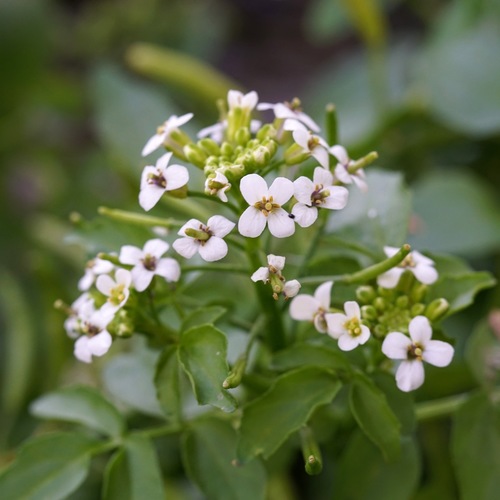
Watercress is characterized by its bright green, pinnately compound leaves, each with several round to oval leaflets. The stems are hollow, succulent, and light green, often trailing or floating on the water's surface, sometimes rooting at the nodes. It produces small, delicate clusters of four-petaled white flowers at the tips of its stems, particularly in spring and summer. The overall appearance is a lush, vibrant green mat, often with submerged roots anchoring it to the substrate.
Categoría
PlantasRareza
Common
Peligro
1/5 · Muy bajo
Snaps
¡Sé la primera persona en hacer un snap!
Despite its name, watercress is not related to garden nasturtiums (Tropaeolum species); its scientific genus 'Nasturtium' refers to its pungent taste.
It has a distinctive peppery, slightly bitter taste due to the presence of isothiocyanates, which are compounds also found in mustard and horseradish.
Watercress is one of the oldest known leaf vegetables consumed by humans, with historical records of its use dating back thousands of years.
Watercress is packed with vitamins A, C, and K, as well as several minerals, making it a highly nutritious 'superfood'.
Watercress can rapidly colonize suitable aquatic environments through both seed dispersal and vegetative propagation, quickly forming dense mats.
This plant is highly efficient at absorbing dissolved nutrients, including nitrates and phosphates, from the water, which can contribute to its nutritional value and its role in ecosystem purification.
Its hollow stems contribute to buoyancy, allowing the plant to float and access sunlight while its roots remain anchored in the water or substrate.
As an autotroph, watercress produces its own food through photosynthesis, utilizing sunlight, carbon dioxide, and water. It absorbs essential minerals and nutrients directly from the water in which it grows.
Salmo trutta
Watercress provides shelter and potential food for various aquatic invertebrates and fish. Its presence can indicate good water quality, which benefits sensitive species.
Arvicola amphibius
Water voles are herbivorous mammals that often feed on a variety of aquatic plants, including the leaves and stems of watercress, as part of their diet.
Lymnaea stagnalis
Various aquatic snails are herbivores that graze on the leaves of submerged and emergent aquatic vegetation, including watercress.
Myosotis scorpioides
Watercress can compete for light and space with other aquatic plants in freshwater habitats, especially in slow-moving or still waters.
Aún no hay insignias de rasgos asignadas a este objeto.
Todavía no hay alias listados.
Las colecciones para este objeto aparecerán aquí a medida que se añadan más temas.
Peligro
1/5 · Muy bajo
Todavía no hay notas especiales de seguridad.
La forma más fácil de identificar a Watercress es usar la aplicación de identificación de naturaleza Snappit.
10-60 cm
0.005-0.05 kg
2-5 años
As an autotroph, watercress produces its own food through photosynthesis, utilizing sunlight, carbon dioxide, and water. It absorbs essential minerals and nutrients directly from the water in which it grows.
Watercress thrives in clear, cool, slow-moving to moderately flowing water environments such as springs, shallow streams, riversides, and ditches.
Photosynthesis And Nutrient Absorption
Acércate para separar los grupos y explorar dónde se ha fotografiado este objeto.
Los snaps recientes aparecerán aquí a medida que se añadan nuevas observaciones.









.jpg&width=800)




