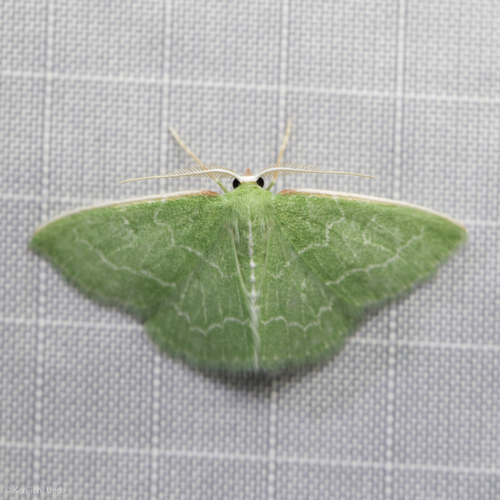


Wavy-Lined And Southern Emeralds
synchlora aerata
The Wavy-Lined and Southern Emeralds (Synchlora aerata) are enchanting small moths belonging to the Geometridae family, aptly named "Emeralds" for their vibrant green coloration. These fascinating insects are a common sight across much of eastern North America, often flitting through meadows and gardens during warmer months. They undergo a complete metamorphosis, with their larval stage showcasing a unique and highly effective camouflage strategy, making them a true marvel of natural adaptation. Adults are delicate, nocturnal fliers, playing a role as pollinators while their caterpillars are specialized herbivores. Their presence often indicates a healthy, biodiverse environment.
Hábitat: This species is typically found in open woodlands, forest edges, meadows, gardens, and other areas with abundant herbaceous vegetation, especially where their host plants thrive.
Adult Wavy-Lined and Southern Emeralds are characterized by their striking pale green wings, often adorned with faint white, wavy lines that give them their common name. These lines can be more prominent or subdued depending on the individual and subspecies. Their body is also green, blending seamlessly with their wings. They are relatively small, with a wingspan typically ranging from 1.5 to 3 centimeters. The overall impression is one of a delicate, leaf-like insect, providing excellent camouflage amongst foliage.
Categoría
InsectosRareza
Common
Peligro
1/5 · Muy bajo
Snaps
¡Sé la primera persona en hacer un snap!
The brilliant green color of these moths is so effective as camouflage that they can often be overlooked even when resting on plain green leaves or stems, blending perfectly into their surroundings.
The caterpillars of the Wavy-Lined and Southern Emeralds are master disguise artists, using tiny hooks on their bodies to attach fragments of flowers and leaves, creating a living camouflage that makes them almost invisible to predators.
The common name 'Wavy-Lined Emerald' refers to the subtle white lines across their wings, which can vary in prominence, while 'Southern Emerald' hints at their distribution across the warmer parts of their range.
Unlike many moths that have drab coloration, the 'Emeralds' family is known for its beautiful green hues, a testament to evolutionary pressures for daytime camouflage despite many being nocturnal.
The caterpillars of Synchlora aerata possess a remarkable ability to camouflage themselves by attaching bits of plant debris, petals, or other organic material onto specialized hooks on their bodies, making them virtually indistinguishable from their surroundings.
Both larvae and adults exhibit a vivid green coloration that provides exceptional crypsis, allowing them to blend seamlessly with leaves and stems, protecting them from avian and other predators.
This species can produce several generations within a single warm season, enabling them to rapidly reproduce and take advantage of favorable environmental conditions from late spring through early autumn.
The larvae of the Wavy-Lined and Southern Emeralds are obligate herbivores, feeding on the foliage and flowers of a variety of herbaceous plants. Adult moths primarily consume nectar from various flowering plants, providing energy for flight and reproduction.
Diferencias por edad: Yes, larvae feed on plant tissues (leaves, flowers) while adults feed on nectar.
Solidago canadensis
Host plant for larval development.
Achillea millefolium
Host plant for larval development.
Myotis lucifugus
Predator of adult moths.
Turdus migratorius
Predator of larval and adult moths.
Aún no hay insignias de rasgos asignadas a este objeto.
Todavía no hay alias listados.
Las colecciones para este objeto aparecerán aquí a medida que se añadan más temas.
Peligro
1/5 · Muy bajo
Todavía no hay notas especiales de seguridad.
La forma más fácil de identificar a Wavy-Lined And Southern Emeralds es usar la aplicación de identificación de naturaleza Snappit.
1 cm
1-3 cm
0.0001-0.0005 kg
0 años
The larvae of the Wavy-Lined and Southern Emeralds are obligate herbivores, feeding on the foliage and flowers of a variety of herbaceous plants. Adult moths primarily consume nectar from various flowering plants, providing energy for flight and reproduction.
This species is typically found in open woodlands, forest edges, meadows, gardens, and other areas with abundant herbaceous vegetation, especially where their host plants thrive.
Foraging (larvae), Nectaring (adults)
Acércate para separar los grupos y explorar dónde se ha fotografiado este objeto.
Los snaps recientes aparecerán aquí a medida que se añadan nuevas observaciones.




_I.jpg&width=800)








