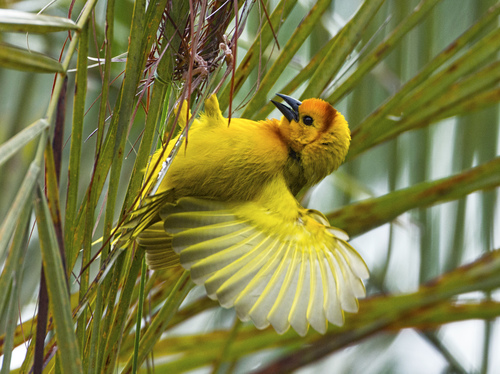


Weavers And Allies
ploceidae
Weavers and Allies, belonging to the family Ploceidae, are a diverse and fascinating group of small passerine birds renowned for their incredible nest-building skills. Chiefly native to Sub-Saharan Africa, though also found in tropical Asia, these highly social birds are famous for constructing elaborate, hanging structures woven from grass, twigs, and leaf strips. Their complex nesting colonies are a marvel of nature, transforming trees into bustling, noisy avian cities. Beyond their engineering feats, weavers play an essential role in their ecosystems as seed dispersers and insect controllers. During the breeding season, many male weavers undergo dramatic physical transformations, trading their drab, brown non-breeding plumage for vibrant displays of bright yellow, fiery orange, and rich red to attract mates, accompanying these looks with energetic, acrobatic courtship displays.
Hábitat: Typically found in a variety of open environments including savannas, grasslands, agricultural areas, and shrublands, often near wetlands or water bodies.
Weavers are typically small to medium-sized birds with stout, conical bills well-suited for cracking seeds. During the non-breeding season, both sexes generally exhibit cryptically colored, sparrow-like plumage dominated by streaked browns and buffs. However, breeding males of many species showcase brilliant, highly contrasting colors including bright yellow, orange, crimson, and jet black, often with distinct facial masks. They range in size from around 8 to 24 centimeters, featuring short, rounded wings and sturdy legs adapted for clinging to swaying grasses and branches.
Categoría
AvesRareza
Common
Peligro
1/5 · Muy bajo
Snaps
¡Sé la primera persona en hacer un snap!
Male weavers are meticulous builders; if a female rejects his newly woven nest, the male will often tear it down and start over from scratch.
Sociable weavers build massive communal nests that can weigh over a ton, housing up to several hundred birds across multiple generations.
The Red-billed Quelea is considered the most numerous wild bird species in the world, with populations estimated in the billions.
Males use their feet and strong beaks to tie knots and weave complex, hanging nests from grass and leaves to attract mates.
They breed in large, dense colonies that provide safety in numbers, making it difficult for predators to approach unnoticed.
Capable of hanging completely upside down from thin grass stems or twigs to strip leaves for nesting or to feed on seeds.
Their diet consists primarily of grass seeds and agricultural grains, supplemented heavily with insects, spiders, and occasional nectar during the breeding season.
Diferencias por edad: Chicks are fed an insect-rich diet for high-protein growth before transitioning to a seed-dominant diet as they mature.
Dispholidus typus
Preys upon eggs and nestlings by entering the woven hanging nests.
Chrysococcyx caprius
Acts as a brood parasite, laying its eggs in weaver nests to be raised by the weaver parents.
Vachellia tortilis
Provides crucial nesting sites and protection from predators with its sharp thorns.
Aún no hay insignias de rasgos asignadas a este objeto.
Todavía no hay alias listados.
Las colecciones para este objeto aparecerán aquí a medida que se añadan más temas.
Peligro
1/5 · Muy bajo
Todavía no hay notas especiales de seguridad.
La forma más fácil de identificar a Weavers And Allies es usar la aplicación de identificación de naturaleza Snappit.
8-24 cm
18-38 cm
0.012-0.1 kg
2-8 años
50 km/h
Their diet consists primarily of grass seeds and agricultural grains, supplemented heavily with insects, spiders, and occasional nectar during the breeding season.
Typically found in a variety of open environments including savannas, grasslands, agricultural areas, and shrublands, often near wetlands or water bodies.
Acércate para separar los grupos y explorar dónde se ha fotografiado este objeto.
Los snaps recientes aparecerán aquí a medida que se añadan nuevas observaciones.













_-_Meleagris_gallopavo%2C_Occoquan_Bay_National_Wildlife_Refuge%2C_Woodbridge%2C_Virginia.jpg&width=800)

