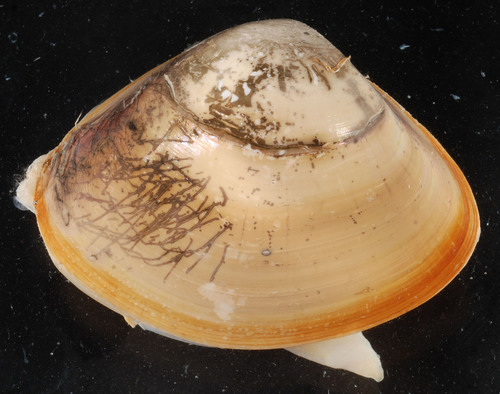


West Atlantic Surfclam
spisula solidissima
The West Atlantic Surfclam, also known as the bar clam or hen clam, is a large, robust marine bivalve native to the western Atlantic Ocean. Thriving in the turbulent waters of the sandy surf zone, this impressive clam plays an essential role in its coastal ecosystem by filtering immense quantities of seawater and helping to stabilize shifting sands. It is one of the most commercially valuable clam species in North America, widely harvested for seafood dishes like clam chowders and fried clam strips. Despite heavy harvesting pressures, active management and sustainable fishing practices have helped maintain healthy populations of this resilient mollusk.
Hábitat: Found in the shallow subtidal zone of sandy beaches and continental shelves, typically burrowed in clean sand from the low tide mark down to depths of about 60 meters.
The West Atlantic Surfclam features a large, heavy, and triangularly oval shell that typically reaches 10 to 22 centimeters in length. The shell's exterior is relatively smooth with fine, concentric growth lines and is covered in a thin, yellowish-brown outer skin that often wears away to reveal a chalky, off-white base. Inside, the shell is smooth and white, featuring a prominent, spoon-shaped hinge cavity where the internal ligament attaches, distinguishing it from other beach-dwelling bivalves.
Categoría
InvertebrateRareza
Common
Peligro
1/5 · Muy bajo
Snaps
¡Sé la primera persona en hacer un snap!
A single female surfclam can release up to several self-produced millions of eggs into the water column during a single spawning event.
Much like counting the rings of a tree, scientists can determine the precise age of a surfclam by counting the annual growth lines on its cross-sectioned shell.
They are the primary species harvested for the commercial clam strip and clam chowder industries in the United States.
Uses a highly muscular, tongue-shaped foot to anchor itself and quickly pull its shell deep into loose, wet sand to escape heavy waves and predators.
Capable of processing gallons of seawater every hour, filtering out organic particles and plankton while purifying the local aquatic environment.
Features long, muscular siphons that extend to the surface of the sand to draw in oxygenated water and food while keeping the body safely buried.
As a suspension feeder, it sucks in seawater through its incurrent siphon, using its gills to trap microscopic organisms and organic particles.
Diferencias por edad: Planktonic larvae feed exclusively on tiny microalgae, while settled adults filter a wider variety of phytoplankton and organic particulate matter.
Neverita duplicata
Prays upon the surfclam by drilling a neat, countersunk hole directly through its thick shell to consume the soft inner tissues.
Asterias forbesi
Uses its powerful water vascular system and tube feet to pry open young surfclams on the ocean floor.
Homo sapiens
Harvests adult surfclams on a massive commercial scale using hydraulic dredges for food products.
Aún no hay insignias de rasgos asignadas a este objeto.
Todavía no hay alias listados.
Las colecciones para este objeto aparecerán aquí a medida que se añadan más temas.
Peligro
1/5 · Muy bajo
Todavía no hay notas especiales de seguridad.
La forma más fácil de identificar a West Atlantic Surfclam es usar la aplicación de identificación de naturaleza Snappit.
10-22 cm
0.2-0.9 kg
15-40 años
As a suspension feeder, it sucks in seawater through its incurrent siphon, using its gills to trap microscopic organisms and organic particles.
Found in the shallow subtidal zone of sandy beaches and continental shelves, typically burrowed in clean sand from the low tide mark down to depths of about 60 meters.
Filtering
18-35 días
Acércate para separar los grupos y explorar dónde se ha fotografiado este objeto.
Los snaps recientes aparecerán aquí a medida que se añadan nuevas observaciones.

Massachusetts, US
Puedes ver Gaviota Argéntea Americana y éider Común.
Ver guía →

New York, US
Puedes ver Tortuga De Caja Oriental, águila Pescadora y Monarch.
Ver guía →

Massachusetts, US
Puedes ver Woolly Beachheather y Gaviota Argéntea Americana.
Ver guía →



_-_Unionidae_-_Mollusc_shell.jpeg&width=800)






