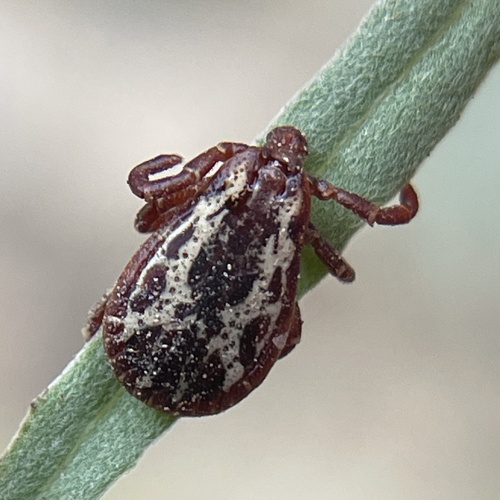


Western Dog Tick
dermacentor similis
The Western Dog Tick (Dermacentor similis) is a highly resilient hard tick species found throughout the western regions of North America. Renowned for its hardiness and parasitic lifestyle, this arachnid plays a significant role in its local ecosystems as a vector for various microorganisms and as a food source for several insectivorous animals. It is particularly well-known for its association with domestic dogs, wild canids, and larger mammals, including humans. Despite their unpopular reputation, these ticks possess remarkable physiological adaptations. They can endure extreme environmental conditions and survive for many months without feeding, waiting patiently in the brush for a suitable host to pass by. Understanding their behavior and life cycle is crucial for hikers, pet owners, and outdoor enthusiasts navigating their shared environments.
Hábitat: Found in brushy areas, tall grasslands, chaparral, woodland trails, and transition zones between forests and fields where hosts frequently travel.
Adult Western Dog Ticks are relatively large, flat, oval-shaped arachnids, measuring about 3 to 5 mm in length when unfed, but expanding significantly up to 15 mm and turning a bluish-grey color when fully engorged. They exhibit a distinct ornate scutum (dorsal shield) featuring prominent silver-grey or whitish ornate markings on a dark brown background. Males have a fully covered ornate back, while females have a smaller ornate scutum near the front, leaving the rest of their dark brown abdomen exposed to stretch during feeding. Like all arachnids, adults and nymphs have eight legs, while the tiny larvae have only six.
Categoría
InvertebrateRareza
Common
Peligro
1/5 · Muy bajo
Snaps
¡Sé la primera persona en hacer un snap!
A single female Western Dog Tick can lay up to 6,000 eggs in leaf litter before she dies.
They do not jump or fly; instead, they rely entirely on direct physical contact when hosts brush past their questing positions.
They utilize a specialized sensory cavity on their front legs called Haller's organ to detect chemical cues, moisture, and temperature changes.
The tick climbs to the tips of grasses and shrubs, extending its front legs to detect the heat, carbon dioxide, and vibrations of passing hosts.
They can survive for several months, and sometimes over a year, without a single blood meal by drastically lowering their metabolic rate.
Their saliva contains specialized compounds that numb the host's skin, prevent blood clotting, and suppress the immune response, allowing undetected feeding.
Feeds exclusively on the blood of mammalian hosts to complete its life cycle.
Diferencias por edad: Larvae and nymphs feed on smaller rodents, whereas adults target larger mammals.
Canis lupus familiaris
Adult ticks parasitize dogs for a blood meal.
Peromyscus maniculatus
Larval ticks parasitize deer mice.
Sceloporus occidentalis
Often consumed by western fence lizards as part of their diet.
Aún no hay insignias de rasgos asignadas a este objeto.
Todavía no hay alias listados.
Las colecciones para este objeto aparecerán aquí a medida que se añadan más temas.
Peligro
1/5 · Muy bajo
Todavía no hay notas especiales de seguridad.
La forma más fácil de identificar a Western Dog Tick es usar la aplicación de identificación de naturaleza Snappit.
1-2 cm
0.000002-0.00015 kg
1-3 años
Feeds exclusively on the blood of mammalian hosts to complete its life cycle.
Found in brushy areas, tall grasslands, chaparral, woodland trails, and transition zones between forests and fields where hosts frequently travel.
Ambush
2000-6000
Acércate para separar los grupos y explorar dónde se ha fotografiado este objeto.
Los snaps recientes aparecerán aquí a medida que se añadan nuevas observaciones.




.jpg&width=800)







