

Western Juniper
juniperus occidentalis
The Western Juniper (Juniperus occidentalis) is a robust, long-lived evergreen conifer native to the high deserts and mountainous regions of the western United States. Growing in harsh, arid landscapes where other trees struggle to survive, these resilient trees can live for well over a thousand years. They play a critical role in their ecosystems, providing essential shelter and food for a variety of high-desert wildlife, while their extensive root systems help prevent soil erosion in fragile arid terrains. Historically, indigenous peoples utilized Western Juniper for wood, medicine, and ceremonial purposes. Today, they are admired for their twisted, weathered forms, which reflect their struggles against the elements. Their ability to thrive in poor, rocky soils and survive prolonged droughts makes them a true symbol of endurance in the American West.
Hábitat: Found in dry, rocky plains, foothills, and mountain slopes of the high desert regions of the western United States, typically at elevations between 1,000 and 3,000 meters.
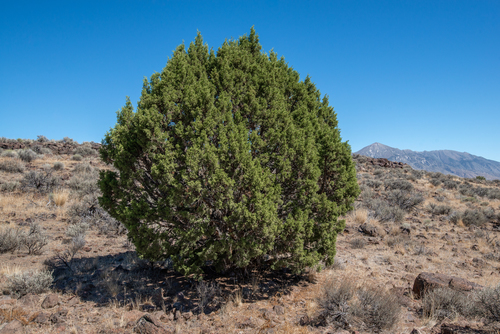
The Western Juniper is characterized by its rugged, twisted trunk covered in shredded, fibrous, gray-brown bark. Typically reaching heights of 5 to 15 meters, it features a rounded, asymmetrical crown that becomes increasingly gnarly with age. Its scale-like leaves are yellow-green, arranged in alternating whorls of three, and often feature a white resin gland on the back. The tree produces fleshy, berry-like seed cones that are spherical, measuring about 6 to 10 millimeters in diameter, which transition from green to a dusty, glaucous blue-black color when mature. Older trees often exhibit dead branches and a deeply weathered, sculptural appearance.
Categoría
PlantasRareza
Common
Peligro
1/5 · Muy bajo
Snaps
¡Sé la primera persona en hacer un snap!
Because Western Juniper wood is highly resistant to decay and insect damage, fallen logs can remain intact on the dry desert floor for hundreds of years.
Despite their common name 'berries', the blue-colored structures on Western Junipers are actually fleshy, modified seed cones containing 1 to 3 seeds.
Some Western Juniper specimens are estimated to be over 1,600 years old, making them among the oldest living organisms in the Pacific Northwest.
An extremely deep taproot system combined with widespread lateral roots allows the tree to access deep underground water sources and survive prolonged dry spells.
The scale-like, resinous leaves are highly adapted to minimize water loss and withstand extreme freezing temperatures common in high-desert winters.
Its heartwood is packed with natural aromatic compounds and resins that repel insects, fungi, and rot, allowing dead wood to persist for decades.
As a photosynthetic plant, the Western Juniper produces its own food using sunlight, carbon dioxide, and water absorbed from the soil.
Myadestes townsendi
Townsend's Solitaires rely heavily on Western Juniper berries for food during winter and assist the tree in seed dispersal.
Odocoileus hemionus
Mule deer forage on the foliage and twigs of the Western Juniper during harsh winters and use the canopy for thermal cover.
Phoradendron juniperinum
Juniper Mistletoe is a hemiparasitic plant that grows on the branches of the Western Juniper, extracting water and nutrients.
Aún no hay insignias de rasgos asignadas a este objeto.
Todavía no hay alias listados.
Las colecciones para este objeto aparecerán aquí a medida que se añadan más temas.
Peligro
1/5 · Muy bajo
Todavía no hay notas especiales de seguridad.
La forma más fácil de identificar a Western Juniper es usar la aplicación de identificación de naturaleza Snappit.
500-1500 cm
300-1600 años
As a photosynthetic plant, the Western Juniper produces its own food using sunlight, carbon dioxide, and water absorbed from the soil.
Found in dry, rocky plains, foothills, and mountain slopes of the high desert regions of the western United States, typically at elevations between 1,000 and 3,000 meters.
Photosynthesis
Acércate para separar los grupos y explorar dónde se ha fotografiado este objeto.
Los snaps recientes aparecerán aquí a medida que se añadan nuevas observaciones.

Oregon, US
Puedes ver Linaria De Dalmacia, Artemisa Grande y Western Juniper.
Ver guía →

Oregon, US
Puedes ver Ciervo Mulo, Gorrión Melódico y Western Juniper.
Ver guía →

Oregon, US
Puedes ver Munro's Globemallow y Blue Mountain Prairie Clover.
Ver guía →