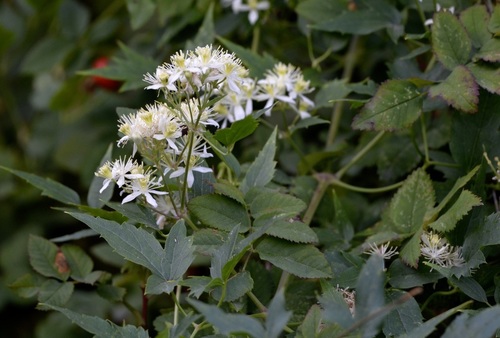


Western White Clematis
clematis ligusticifolia
Western White Clematis (Clematis ligusticifolia), also known as virgin's bower, is a vigorous deciduous climbing vine native to western North America. It drapes itself gracefully over shrubs, fences, and trees, blanketing them in cascading clusters of creamy white flowers during the late summer. Indigenous peoples historically utilized this versatile plant for various medicinal purposes, including pain relief, and even as a soap substitute due to the saponins present in its leaves. In late autumn, the flowers give way to spectacular, feathery seed heads that catch the sunlight and shimmer in the breeze, providing a vital source of aesthetic delight and wildlife habitat long after the summer bloom has faded.
Hábitat: Found in riparian woodlands, moist canyons, forest edges, and sagebrush scrub throughout western North America.
This climbing woody vine can reach lengths of 2 to 6 meters, climbing by means of twisting leaf petioles. Its leaves are pinnately compound, typically featuring 5 leaflets with coarsely toothed margins. The star-like flowers, measuring about 1.5 to 2.5 cm across, lack true petals but boast four showy, petal-like white to cream sepals surrounding numerous conspicuous stamens. As winter approaches, the female plants produce distinctive, dense clusters of silky, feathery, long-tailed achenes (fruits) that resemble fluffy pom-poms or white beards.
Categoría
PlantasRareza
Common
Peligro
1/5 · Muy bajo
Snaps
¡Sé la primera persona en hacer un snap!
Despite its beauty, the plant is toxic if consumed raw due to protoanemonin, which causes severe irritation to the mouth and digestive tract.
Native Americans used the crushed roots and leaves of this plant to treat chest pain, and the Spanish called it 'Yerba de Chivato' (goat weed).
The fluffy, silky seed heads were historically used by indigenous tribes as insulation for shoes and as stuffing for pillows.
The vine utilizes sensitive, twining leaf stalks (petioles) to wrap around surrounding vegetation and structures, climbing rapidly toward sunlight without needing a thick, self-supporting woody trunk.
Its seeds are equipped with long, plume-like, hairy styles that act as miniature parachutes, enabling wind-assisted dispersal over significant distances.
The plant contains protoanemonin, a bitter chemical compound that deters most mammalian herbivores from grazing on its leaves and stems.
As a photosynthetic plant, it synthesizes its own sugars using sunlight, water, carbon dioxide, and essential soil nutrients.
Apis mellifera
Provides nectar and pollen to adult honey bees.
Alcathoe caudata
Serves as a larval host plant for the caterpillars of this moth species.
Psaltriparus minimus
Dense, tangled vines provide nesting sites and protective cover for small songbirds.
Aún no hay insignias de rasgos asignadas a este objeto.
Todavía no hay alias listados.
Las colecciones para este objeto aparecerán aquí a medida que se añadan más temas.
Peligro
1/5 · Muy bajo
Todavía no hay notas especiales de seguridad.
La forma más fácil de identificar a Western White Clematis es usar la aplicación de identificación de naturaleza Snappit.
200-600 cm
5-20 años
As a photosynthetic plant, it synthesizes its own sugars using sunlight, water, carbon dioxide, and essential soil nutrients.
Found in riparian woodlands, moist canyons, forest edges, and sagebrush scrub throughout western North America.
30-90 días
Acércate para separar los grupos y explorar dónde se ha fotografiado este objeto.
Los snaps recientes aparecerán aquí a medida que se añadan nuevas observaciones.