

Whipple Cholla
cylindropuntia whipplei
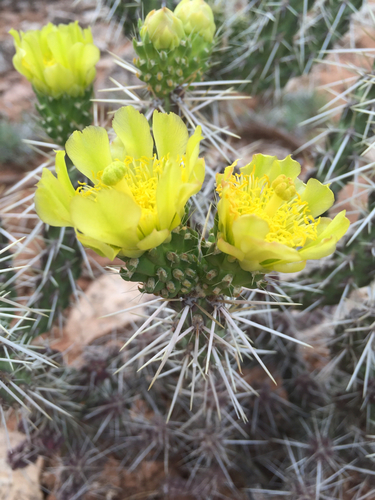
Whipple Cholla, scientifically known as Cylindropuntia whipplei, is a highly branched, shrubby cactus native to the high-desert regions of the southwestern United States. Often forming dense, low-growing thickets, this resilient species is well-adapted to the cold winters and dry, scorching summers of the Colorado Plateau. It stands out in its arid landscape by maintaining a vibrant pale-green coloration and producing small, chartreuse flowers that mature into fleshy, yellow, spineless fruits.
Hábitat: Typically found on sandy plains, rocky slopes, and clay soils within desert grasslands and pinyon-juniper woodlands.
This cactus typically grows as a low, sprawling shrub or upright clump between 30 to 150 centimeters tall. It features cylindrical, deeply tuberculate green stems densely covered in pale white or yellow spines. The spines are encased in translucent, papery sheaths that reflect light, giving the plant a shimmering silvery appearance. In late spring, it produces yellow-green flowers about 2 to 3 centimeters wide, followed by persistent, knobby, bright yellow fruits.
Categoría
PlantasRareza
Common
Peligro
1/5 · Muy bajo
Snaps
¡Sé la primera persona en hacer un snap!
Because the stem joints detach so easily and latch onto passing animals, this plant is nicknamed 'hitchhiker' as a primary way to colonize new territory.
Native American tribes, including the Hopi, historically utilized the yellow fruits as food, eating them raw, stewed, or dried for winter storage.
The papery sheaths surrounding the spines act like miniature sun umbrellas, reducing the ambient temperature of the plant's skin.
Its spines are covered in papery, translucent sheaths that reflect intense solar radiation, cooling the stem and reducing water loss.
The stem joints are highly detaching; when they fall or are carried away by animals, they easily root in the soil to form new clonal plants.
It utilizes CAM photosynthesis, opening its stomata at night to absorb carbon dioxide and minimizing water evaporation during the hot day.
As a photosynthetic plant, it produces its own energy using sunlight, water, and carbon dioxide.
Campylorhynchus brunneicapillus
Provides critical nesting sites, physical protection from predators, and food source for the birds.
Ovis canadensis nelsoni
Feeds on the spineless yellow fruits and occasionally the fleshy stems during drought conditions.
Diadasia rinconis
Visits the greenish-yellow flowers to gather pollen and nectar, acting as a primary pollinator.
Aún no hay insignias de rasgos asignadas a este objeto.
Todavía no hay alias listados.
Las colecciones para este objeto aparecerán aquí a medida que se añadan más temas.
Peligro
1/5 · Muy bajo
Todavía no hay notas especiales de seguridad.
La forma más fácil de identificar a Whipple Cholla es usar la aplicación de identificación de naturaleza Snappit.
30-150 cm
1-25 kg
20-100 años
As a photosynthetic plant, it produces its own energy using sunlight, water, and carbon dioxide.
Typically found on sandy plains, rocky slopes, and clay soils within desert grasslands and pinyon-juniper woodlands.
Foraging
Acércate para separar los grupos y explorar dónde se ha fotografiado este objeto.
Los snaps recientes aparecerán aquí a medida que se añadan nuevas observaciones.

New Mexico, US
Puedes ver Pinkflower Hedgehog Cactus y Cactus De Copa De Vino.
Ver guía →

New Mexico, US
Puedes ver Cuervo Común, Gorrión Común y Chamizo De Cuatro Alas.
Ver guía →

Colorado, US
Puedes ver Ciervo Mulo, Chamisa y Lagartija Espinosa De Meseta.
Ver guía →
















