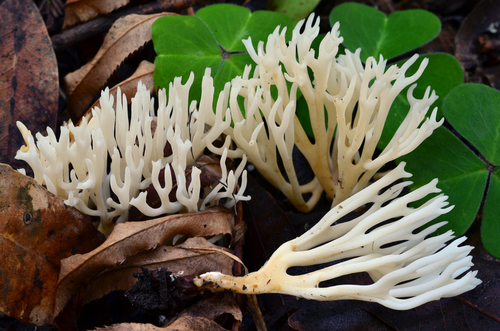


White Coral Fungus
ramariopsis kunzei
The White Coral Fungus, Ramariopsis kunzei, is a delicate and captivating organism that graces the forest floor with its intricate, coral-like formations. Often mistaken for a piece of marine life dropped into a woodland setting, its pristine white appearance makes it a striking discovery for anyone exploring temperate forests. This fungus is a crucial member of the decomposer community, diligently breaking down organic matter, such as fallen leaves and decaying wood, and returning vital nutrients to the ecosystem. Its presence signals a healthy forest environment, where natural processes of decay and regeneration are actively taking place. Observing Ramariopsis kunzei offers a unique glimpse into the unseen, yet essential, world of fungal ecology and the intricate web of life beneath our feet. Its elegant form and ecological importance make it a fascinating subject for mycologists and casual nature enthusiasts alike.
Hábitat: The White Coral Fungus is commonly found growing solitarily or in scattered groups on decaying leaf litter, woody debris, or directly on the soil in mixed deciduous and coniferous forests.
This fungus is readily identified by its pure white, sometimes creamy, branching fruiting body, strongly resembling a tiny, bleached coral structure. It typically grows upright, forming dense, fan-like or shrubby clusters. The branches are often slender, smooth, and cylindrical, tapering slightly towards their tips, which may be blunt or finely pointed. Individual structures can range from 3 to 10 cm in height and spread across a similar width. The texture is firm but somewhat brittle.
Categoría
HongosRareza
Common
Peligro
1/5 · Muy bajo
Snaps
¡Sé la primera persona en hacer un snap!
Despite its delicate look, the fruiting body is surprisingly firm and can remain intact for several weeks after emerging.
Its appearance often leads people to mistake it for a marine coral that has somehow ended up on the forest floor.
Ramariopsis kunzei is non-toxic but considered inedible due to its tough texture and lack of distinct flavor.
The intricate branching structure maximizes surface area for spore dispersal, allowing the fungus to effectively spread its genetic material through the environment.
Efficiently breaks down complex organic compounds in dead plant material, returning essential nutrients like nitrogen and carbon to the soil, which are then available for other plants and organisms.
Unlike many ephemeral fungi, the delicate yet firm structure of Ramariopsis kunzei can persist for several weeks, allowing for extended spore dispersal and visibility in the environment.
Possesses specialized enzymes to digest lignin and cellulose, the primary components of wood and plant matter, making it a key player in forest decomposition.
The White Coral Fungus is a saprobic organism, meaning it obtains its nutrients by decomposing dead organic matter such as leaf litter, decaying wood, and forest debris. It plays a vital role in nutrient cycling within its ecosystem.
Quercus alba
Decomposes and recycles nutrients from fallen leaves.
Collembola species
Provides food source for various forest invertebrates.
Tsuga canadensis
Facilitates decomposition of dead wood.
Various soil bacteria
Breaks down organic matter alongside other soil fungi and bacteria.
Aún no hay insignias de rasgos asignadas a este objeto.
Todavía no hay alias listados.
Las colecciones para este objeto aparecerán aquí a medida que se añadan más temas.
Peligro
1/5 · Muy bajo
Todavía no hay notas especiales de seguridad.
La forma más fácil de identificar a White Coral Fungus es usar la aplicación de identificación de naturaleza Snappit.
3-10 cm
0.005-0.05 kg
1-5 años
The White Coral Fungus is a saprobic organism, meaning it obtains its nutrients by decomposing dead organic matter such as leaf litter, decaying wood, and forest debris. It plays a vital role in nutrient cycling within its ecosystem.
The White Coral Fungus is commonly found growing solitarily or in scattered groups on decaying leaf litter, woody debris, or directly on the soil in mixed deciduous and coniferous forests.
Foraging
Acércate para separar los grupos y explorar dónde se ha fotografiado este objeto.
Los snaps recientes aparecerán aquí a medida que se añadan nuevas observaciones.









.jpg&width=800)