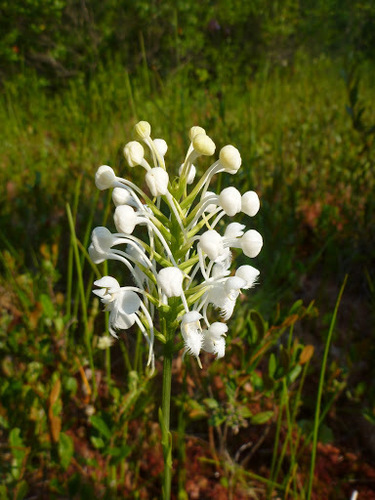


White-Fringed Orchid
platanthera blephariglottis
The White-Fringed Orchid (Platanthera blephariglottis) is a stunning native wildflower of North America, famed for its elegant, pure white blossoms. Thriving in acidic wetlands, sphagnum bogs, and wet pine barrens, this terrestrial orchid produces an upright spike crowded with heavily fringed flowers. Each flower possesses a long, slender nectar spur, making them highly specialized for pollination by nocturnal and crepuscular moths. In addition to its aesthetic beauty, this orchid is a key indicator species of healthy, undisturbed wetland ecosystems. Its reliance on specific mycorrhizal fungi for seed germination and its complex reproductive relationships highlight the intricate web of ecological interactions in native bog habitats, making it a highly prized sighting for botanists and nature enthusiasts alike.
Hábitat: Typically found in acidic, nutrient-poor wetlands, particularly sphagnum bogs, fens, wet meadows, and pine savannahs.
This terrestrial orchid stands between 20 and 100 cm tall, featuring an unbranched, erect stem clasping several lance-shaped, alternate green leaves that decrease in size as they ascend the stem. The inflorescence is a dense, showy terminal cluster of 30 to 80 pristine white flowers. Each bloom is characterized by a prominent, deeply fringed lower lip (labellum) and a slender, backward-curving nectar spur measuring about 1.5 to 2.5 cm in length, which gives the flowering spike a delicate, lace-like appearance.
Categoría
PlantasRareza
Common
Peligro
1/5 · Muy bajo
Snaps
¡Sé la primera persona en hacer un snap!
The genus name Platanthera is derived from Greek words meaning 'broad anther', referring to the wide reproductive parts characteristic of these orchids.
The orchid's flowers emit a sweet, heavy fragrance specifically at night to guide nocturnal moth pollinators to the nectar.
The tiny seeds are so light and numerous that they are dispersed by the wind like dust particles.
Relies on symbiotic underground fungi to provide essential nutrients to its tiny, dust-like seeds, which lack their own food reserves.
Utilizes a highly specialized, elongated nectar spur that restricts access to long-tongued moths, ensuring high-fidelity pollination.
Possesses key physiological adaptations that allow it to grow and thrive in highly acidic, waterlogged, and nutrient-deficient soils.
Produces its own organic compounds using sunlight, water, and carbon dioxide through photosynthesis, assisted by mycorrhizal fungi in its early life stages.
Diferencias por edad: As a seedling, it relies entirely on mycorrhizal fungi for nutrition before developing green leaves to photosynthesize as an adult.
Hyles lineata
Adult moths sip nectar from the deep spurs, transferring pollen between flowers on their eyes or proboscis.
Ceratobasidium cornigerum
The orchid relies on fungal hyphae to colonize its root system and supply critical water and nutrients.
Aún no hay insignias de rasgos asignadas a este objeto.
Todavía no hay alias listados.
Las colecciones para este objeto aparecerán aquí a medida que se añadan más temas.
Peligro
1/5 · Muy bajo
Todavía no hay notas especiales de seguridad.
La forma más fácil de identificar a White-Fringed Orchid es usar la aplicación de identificación de naturaleza Snappit.
20-100 cm
5-20 años
Produces its own organic compounds using sunlight, water, and carbon dioxide through photosynthesis, assisted by mycorrhizal fungi in its early life stages.
Typically found in acidic, nutrient-poor wetlands, particularly sphagnum bogs, fens, wet meadows, and pine savannahs.
Acércate para separar los grupos y explorar dónde se ha fotografiado este objeto.
Los snaps recientes aparecerán aquí a medida que se añadan nuevas observaciones.









.jpg&width=800)





