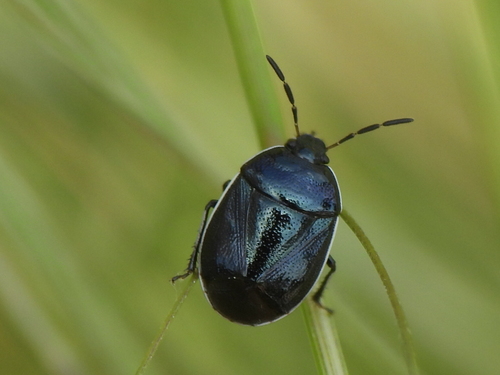


White-Margined Burrowing Bug
sehirus cinctus
The White-Margined Burrowing Bug, Sehirus cinctus, is a fascinating small insect belonging to the true bug family Cydnidae. These charismatic creatures are notable for their distinct black bodies bordered with white or cream margins, making them visually striking despite their diminutive size. Unlike many insects, Sehirus cinctus exhibits remarkable maternal care, with females guarding their eggs and newly hatched nymphs, a behavior more commonly associated with vertebrates. They are primarily herbivores, specializing in feeding on the seeds of various plants, particularly those in the mint family. Their unique combination of striking appearance, specialized diet, and dedicated parental investment makes them a captivating subject for naturalists and a testament to the diverse strategies found within the insect world.
Hábitat: Found in open woodlands, fields, gardens, and disturbed areas where their host plants, particularly members of the mint family, are abundant, often burrowing shallowly in the soil beneath these plants.
The White-Margined Burrowing Bug is characterized by its glossy black, somewhat flattened oval body, typically measuring between 4.5 and 6.5 millimeters in length. Its most distinctive feature is a prominent white or cream-colored margin that outlines the entire body, from the head to the tip of the abdomen, providing a sharp contrast to its dark background. The antennae are dark, and the legs are black. While they possess wings, they are often observed crawling on the ground or on host plants. The overall appearance is compact and robust, resembling a tiny, highly polished beetle from a distance, but closer inspection reveals the characteristic true bug mouthparts and wing structure.
Categoría
InsectosRareza
Common
Peligro
1/5 · Muy bajo
Snaps
¡Sé la primera persona en hacer un snap!
Despite their name, 'burrowing bugs,' they typically only burrow shallowly into loose soil or leaf litter, rather than creating extensive tunnels.
Females have been observed 'brooding' their egg masses, physically covering them with their bodies to protect them from predators and possibly regulate temperature and humidity.
The White-Margined Burrowing Bug is one of the few insect species known to exhibit parental care, with females actively guarding their eggs and nymphs.
They communicate through substrate vibrations, which are particularly important during courtship and for maternal-offspring interactions.
Females of Sehirus cinctus are known to guard their egg masses and newly hatched nymphs, protecting them from predators and occasionally moving the eggs or young to more favorable locations.
These bugs are adept at burrowing into loose soil, especially at the base of their host plants, providing them with shelter from predators and adverse environmental conditions.
They possess specialized mouthparts adapted for piercing the seed coats of plants and extracting the internal nutrients, making them highly efficient seed consumers.
The White-Margined Burrowing Bug is a specialist herbivore, feeding primarily on the seeds of various plants. Both nymphs and adults use their piercing-sucking mouthparts to extract nutrients from developing and mature seeds.
Marrubium vulgare
A primary food source, the bugs feed on its seeds.
Carabidae (family)
Adults and nymphs can be preyed upon by various ground-dwelling predators.
Scelionidae (family)
These small wasps can parasitize the eggs of burrowing bugs.
Turdus migratorius
Many generalist insectivorous birds will consume burrowing bugs if encountered.
Aún no hay insignias de rasgos asignadas a este objeto.
Todavía no hay alias listados.
Las colecciones para este objeto aparecerán aquí a medida que se añadan más temas.
Peligro
1/5 · Muy bajo
Todavía no hay notas especiales de seguridad.
La forma más fácil de identificar a White-Margined Burrowing Bug es usar la aplicación de identificación de naturaleza Snappit.
0 cm
0-1 cm
0 kg
0-1 años
The White-Margined Burrowing Bug is a specialist herbivore, feeding primarily on the seeds of various plants. Both nymphs and adults use their piercing-sucking mouthparts to extract nutrients from developing and mature seeds.
Found in open woodlands, fields, gardens, and disturbed areas where their host plants, particularly members of the mint family, are abundant, often burrowing shallowly in the soil beneath these plants.
Foraging
Acércate para separar los grupos y explorar dónde se ha fotografiado este objeto.
Los snaps recientes aparecerán aquí a medida que se añadan nuevas observaciones.




















