White-tailed Jackrabbit
Lepus townsendii
The White-tailed Jackrabbit has long ears and powerful legs, perfect for hopping fast! They have a fluffy white tail that stands out when they run away from danger.
Hábitat: Grasslands
The White-tailed Jackrabbit has sandy brown to yellowish-brown fur with a contrasting white belly. Its most distinctive features are its very long, black-tipped ears and a short, fluffy white tail that is visible when it runs.
Categoría
MamíferosRareza
Common
Peligro
1/5 · Muy bajo
Snaps
¡Sé la primera persona en hacer un snap!
Instead of burrows, they hide in shallow, scratched-out dips called "forms."
Jackrabbits got their name because their long ears looked like a donkey's ears!
These aren't true rabbits! They're hares, born with fur and open eyes.
To warn others of danger, they thump their powerful hind feet on the ground.
White-tailed Jackrabbit can sprint up to 55 km/h and zig-zag sharply to escape predators.
White-tailed Jackrabbit has fur that turns white in winter, helping it disappear in snowy landscapes.
White-tailed Jackrabbit has huge swiveling ears that pinpoint faint sounds of approaching danger.
White-tailed Jackrabbit can make long, powerful leaps using its strong hind legs to flee quickly.
These plant-eaters munch on grasses, herbs, and woody plants in their open habitats.
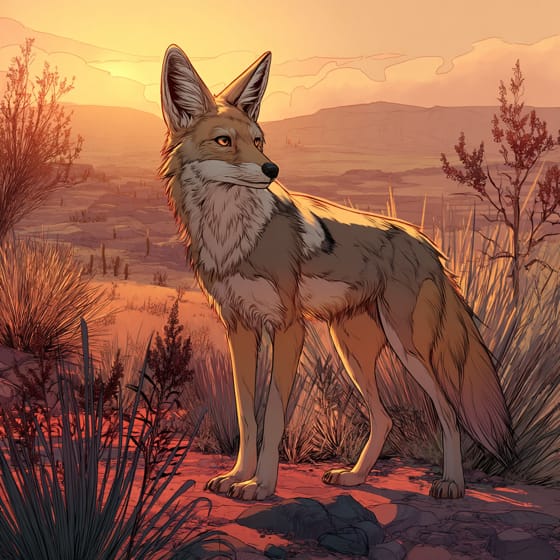
Canis latrans
This predator hunts jackrabbits for food across the plains.
Aquila chrysaetos
Soars above, snatching jackrabbits from open habitats.

Artemisia tridentata
Jackrabbits browse its leaves and twigs, especially in winter.
Bouteloua gracilis
This common grass is a key food source for them.
Peludo describe a los animales que poseen una cubierta densa de pelo o pelaje suave.
Los animales solitarios viven solos durante la mayor parte de su vida y solo interactúan con otros para aparearse o cuidar de sus crías.
El camuflaje describe a los organismos que poseen colores o patrones que les permiten mezclarse con su entorno.
Este rasgo caracteriza a los organismos cuya dieta consiste total o principalmente en material vegetal.

Los hábitats de pastizales son biomas terrestres dominados por pastos y plantas herbáceas, que sustentan a una variedad de animales de pastoreo.

Este rasgo identifica a los organismos que exhiben una rapidez excepcional en sus movimientos para cazar, escapar o desplazarse.
Todavía no hay alias listados.
Peligro
1/5 · Muy bajo
If you see a rabbit, watch quietly from a distance and don't try to touch it.
56-76 cm
2.5-4.3 kg
5-8 años
55 km/h
These plant-eaters munch on grasses, herbs, and woody plants in their open habitats.
Grasslands
Grazing
1-11
Acércate para separar los grupos y explorar dónde se ha fotografiado este objeto.
Los snaps recientes aparecerán aquí a medida que se añadan nuevas observaciones.