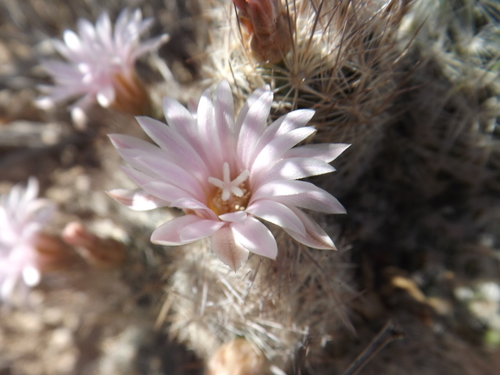


Whitecolumn Foxtail Cactus
escobaria tuberculosa
The Whitecolumn Foxtail Cactus (Escobaria tuberculosa) is a small, resilient succulent native to the rocky soils of the Chihuahuan Desert. Growing in dense clusters or as solitary columns, this plant is famous for its intricate, overlapping white spines that shield its green body from the harsh desert sun. In late spring and summer, it produces delicate, bell-shaped flowers in shades of pale pink to rose-purple, adding a splash of color to the arid landscape. These cacti are beautifully adapted to survive in thin, limestone-rich soils where few other plants can take root. Their ability to nestle into rocky crevices makes them a fascinating find for desert hikers and botanists alike. While small, they play an important ecological role by providing nectar for desert pollinators and stabilizing fragile desert soils.
Hábitat: Found on rocky limestone slopes, gravelly alluvial fans, and arid desert mountain crevices.
This cactus features cylindrical or club-shaped stems growing 5 to 20 centimeters tall and up to 6 centimeters wide. It is heavily shrouded in a dense network of straight, needle-like white spines, with central spines occasionally showing reddish-brown or black tips. The underlying stem is green and divided into prominent spiraling bumps called tubercles. During the blooming season, pale pink or cream-colored flowers up to 2.5 centimeters wide emerge from the apex of the stems, followed by bright red, oval-shaped fruits.
Categoría
PlantasRareza
Common
Peligro
1/5 · Muy bajo
Snaps
¡Sé la primera persona en hacer un snap!
Its scientific name 'tuberculosa' refers to the distinct bump-like structures on its stem, which host the spine clusters.
The common name 'foxtail cactus' comes from the dense, bushy appearance of its white spines, which resemble a fluffy fox tail.
Unlike many desert cacti, the flowers of this species only open fully during the bright, warm afternoon sun and close as twilight approaches.
Dense layers of overlapping white spines reflect intense solar radiation and reduce convective heat loss from dry desert winds.
It absorbs carbon dioxide primarily at night to minimize water loss through transpiration during the blazing hot day.
During periods of severe drought, the root system contracts slightly to pull the cactus body closer to the cooler soil surface.
As an autotrophic plant, it produces its own energy through photosynthesis using sunlight, carbon dioxide, water, and soil minerals.
Diadasia rinconis
Pollinates the cactus flowers while gathering nectar and pollen.
Peromyscus eremicus
Consumes the bright red fruits and acts as an occasional seed disperser.
Larrea tridentata
Acts as a nurse plant, providing vital shade and moisture protection to young cactus seedlings.
Aún no hay insignias de rasgos asignadas a este objeto.
Todavía no hay alias listados.
Las colecciones para este objeto aparecerán aquí a medida que se añadan más temas.
Peligro
1/5 · Muy bajo
Todavía no hay notas especiales de seguridad.
La forma más fácil de identificar a Whitecolumn Foxtail Cactus es usar la aplicación de identificación de naturaleza Snappit.
5-20 cm
0.1-0.8 kg
10-30 años
As an autotrophic plant, it produces its own energy through photosynthesis using sunlight, carbon dioxide, water, and soil minerals.
Found on rocky limestone slopes, gravelly alluvial fans, and arid desert mountain crevices.
Acércate para separar los grupos y explorar dónde se ha fotografiado este objeto.
Los snaps recientes aparecerán aquí a medida que se añadan nuevas observaciones.













.jpg&width=800)






