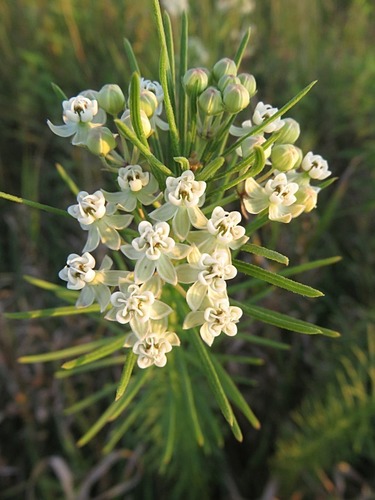


Whorled Milkweed
asclepias verticillata
Whorled Milkweed (Asclepias verticillata) is an elegant, slender perennial wildflower native to eastern and central North America. Unlike its broader-leafed milkweed relatives, this species features thin, needle-like leaves arranged in delicate whorls around a single, erect stem. It stands out in late summer with its clusters of small, fragrant white-to-greenish-white flowers. This plant plays a vital ecological role, acting as a crucial host plant for monarch caterpillars and a magnet for various native pollinators, while also producing a toxic sap that deters generalist herbivores.
Hábitat: Found in dry, open woodlands, prairies, pastures, and along roadsides, often thriving in poor, sandy, or rocky soils.
This herbaceous perennial typically grows to a height of 30 to 90 cm, with narrow, linear leaves measuring 5 to 8 cm long that grow in whorls of 3 to 6 around the stem. In mid-to-late summer, small flat-topped clusters of star-shaped, greenish-white to cream-colored flowers bloom from the upper leaf axils. Each individual flower is roughly 6 mm wide, exhibiting five reflexed petals and a central crown. Following pollination, it produces slender, upright seed pods that dry and split to release fluffy, wind-dispersed seeds.
Categoría
PlantasRareza
Common
Peligro
1/5 · Muy bajo
Snaps
¡Sé la primera persona en hacer un snap!
It is one of the latest-blooming milkweeds, making it an essential late-season nectar source for migrating Monarch butterflies and native bees.
The seeds have silky hairs called floss, which during World War II were collected by school children to stuff military life jackets when traditional materials were scarce.
Whorled Milkweed is one of the most toxic milkweed species to livestock, particularly sheep and horses, earning it a reputation as a rangeland weed.
Produces toxic cardenolides in its milky sap, which deter herbivores and are sequestered by monarch larvae for their own defense.
Utilizes a deep, fibrous root system to access deep water reserves, helping it survive intense droughts and wildfires.
Equips its seeds with fine, silky hairs that catch wind currents, allowing them to disperse over long distances to colonize new open sites.
As a photosynthetic plant, Whorled Milkweed synthesizes its own organic compounds using sunlight, water, carbon dioxide, and mineral nutrients from the soil.
Danaus plexippus
Larvae feed exclusively on the foliage of milkweeds, gaining chemical protection from predators.
Apis mellifera
Adult bees visit the flowers for nectar, successfully pollinating the plant in the process.
Aún no hay insignias de rasgos asignadas a este objeto.
Todavía no hay alias listados.
Las colecciones para este objeto aparecerán aquí a medida que se añadan más temas.
Peligro
1/5 · Muy bajo
Todavía no hay notas especiales de seguridad.
La forma más fácil de identificar a Whorled Milkweed es usar la aplicación de identificación de naturaleza Snappit.
30-90 cm
3-10 años
As a photosynthetic plant, Whorled Milkweed synthesizes its own organic compounds using sunlight, water, carbon dioxide, and mineral nutrients from the soil.
Found in dry, open woodlands, prairies, pastures, and along roadsides, often thriving in poor, sandy, or rocky soils.
Acércate para separar los grupos y explorar dónde se ha fotografiado este objeto.
Los snaps recientes aparecerán aquí a medida que se añadan nuevas observaciones.

Nebraska, US
Puedes ver Monarch, Prairie Blue-Eyed Grass y Puercoespín Norteamericano.
Ver guía →

Maryland, US
Puedes ver Large Field Chickweed, Berro De Roca Lira y Houstonia Azul.
Ver guía →