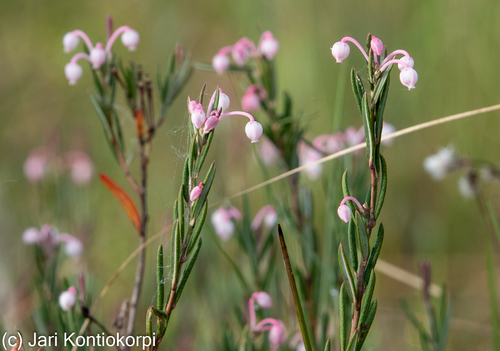


Wild Rosemary
andromeda polifolia
Wild Rosemary (Andromeda polifolia), also known as bog rosemary, is an enchanting, low-growing evergreen shrub native to the cold, acidic peat bogs of the Northern Hemisphere. Belonging to the heath family (Ericaceae), this resilient plant thrives in challenging bog conditions where few other plants can survive. Despite its common name, it is not a true rosemary, but its narrow, needle-like leaves bear a striking resemblance to the culinary herb. Its delicate, pinkish-white, urn-shaped blossoms bring a splash of color to barren wetlands in late spring. It is a vital component of peatland ecosystems, providing microhabitats and floral resources for hardy northern pollinators.
Hábitat: Typically found in acidic peat bogs, fens, and wet heaths of subarctic and temperate regions.
This dwarf shrub grows up to 40 centimeters tall, featuring tough, leathery, lanceolate leaves with distinctive down-turned margins (revolute edges) that are dark blue-green above and powdery white underneath. In late spring and early summer, it displays clusters of nodding, lantern- or bell-shaped flowers that range in color from pale pink to pure white, hanging from the tips of reddish, woody stems.
Categoría
PlantasRareza
Common
Peligro
1/5 · Muy bajo
Snaps
¡Sé la primera persona en hacer un snap!
Despite its common name 'Wild Rosemary', it is highly toxic and completely unrelated to the edible herb rosemary.
Ingesting its leaves can cause serious poisoning due to grayanotoxins, which interfere with cellular sodium channels.
The genus name Andromeda was inspired by the mythological princess chained to a rock, as the plant grows clinging solitary in wet, desolate bogs.
Produces toxic grayanotoxins (andromedotoxin) in its foliage to deter browsing herbivores and insects.
Utilizes specialized ericoid mycorrhizal fungi in its roots to extract nitrogen and phosphorus from nutrient-poor, acidic peatlands.
Employs heavy wax coatings and tightly rolled leaf margins to trap humidity and minimize water loss during frozen winters.
As an autotrophic plant, it produces its own energy via photosynthesis, utilizing sunlight, carbon dioxide, water, and soil minerals.
Sphagnum fuscum
Grows mutualistically within living carpets of Sphagnum moss, which help keep the roots wet and acidic.
Bombus polaris
Flowers are pollinated by cold-tolerant bumblebee species that feed on the nectar.
Exobasidium andromedae
An obligate parasitic fungus that causes severe leaf galling and discoloration on Andromeda species.
Aún no hay insignias de rasgos asignadas a este objeto.
Todavía no hay alias listados.
Las colecciones para este objeto aparecerán aquí a medida que se añadan más temas.
Peligro
1/5 · Muy bajo
Todavía no hay notas especiales de seguridad.
La forma más fácil de identificar a Wild Rosemary es usar la aplicación de identificación de naturaleza Snappit.
10-45 cm
0.02-0.2 kg
5-20 años
As an autotrophic plant, it produces its own energy via photosynthesis, utilizing sunlight, carbon dioxide, water, and soil minerals.
Typically found in acidic peat bogs, fens, and wet heaths of subarctic and temperate regions.
Acércate para separar los grupos y explorar dónde se ha fotografiado este objeto.
Los snaps recientes aparecerán aquí a medida que se añadan nuevas observaciones.













