

Willow Beaked-Gall Midge
rabdophaga rigidae
The Willow Beaked-Gall Midge, Rabdophaga rigidae, is a fascinating insect species known primarily for its intricate relationship with willow trees. These tiny flies induce distinctive galls on the shoots and leaves of their host plants, serving as a protective nursery and food source for their developing larvae. While often overlooked due to their diminutive size, R. rigidae plays a significant role in the local ecosystem, influencing willow plant growth and serving as a food source for various predators and parasitoids. Its life cycle, deeply intertwined with the phenology of willows, exemplifies the complex co-evolutionary dynamics between insects and plants, making it a subject of interest for entomologists and botanists alike.
Hábitat: This species is typically found in environments where willow trees (Salix species) thrive, including riparian zones, wetlands, moist meadows, and along the banks of rivers and streams.
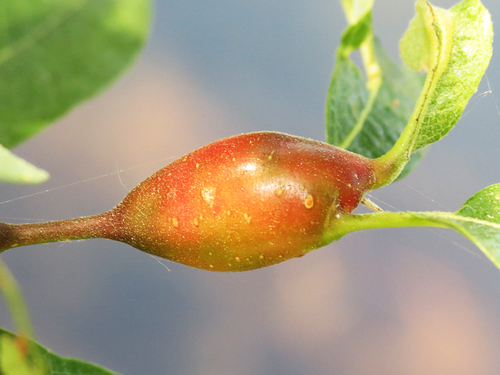
This delicate midge is a very small, slender fly, typically measuring only 2-3 millimeters in length. Its body is generally dull-colored, often brownish or grayish, with a slightly humped thorax and a relatively long abdomen. It possesses a pair of clear, membranous wings that are finely veined, and noticeably long, beaded antennae. The most prominent visual identifier, however, is not the midge itself, but the characteristic 'beaked' galls it forms on willow shoots and leaf petioles. These galls are typically elongated, spindle-shaped swellings, often reddish or yellowish-green, and can be several millimeters long.
Categoría
InsectosRareza
Common
Peligro
1/5 · Muy bajo
Snaps
¡Sé la primera persona en hacer un snap!
Larvae overwinter inside the galls, emerging as adults in the spring or early summer to mate and lay eggs.
The 'beaked' shape of the galls gives this midge its common name, making it relatively easy to identify its presence even when the midge itself is not visible.
The galls themselves are formed by the plant in response to chemical secretions from the midge larvae, redirecting plant growth for the midge's benefit.
While tiny, these galls can sometimes be numerous enough on a single willow branch to be quite conspicuous.
The midge larvae possess the unique ability to manipulate willow plant growth, inducing the formation of a protective gall structure around themselves. This gall provides shelter from predators and a concentrated food source.
Rabdophaga rigidae exhibits strong host specificity, primarily targeting certain species of willow (Salix) for gall formation. This ensures optimal conditions for larval development within a familiar plant chemical environment.
Like many short-lived insects, these midges can complete their life cycle relatively quickly, allowing for multiple generations in a single season. This strategy enhances their population persistence despite high predation rates.
As larvae, the Willow Beaked-Gall Midge feeds exclusively on the plant tissues within the galls they induce on willow trees. Adult midges generally do not feed, focusing solely on reproduction.
Diferencias por edad: Larvae feed on plant tissues inside galls; adults do not feed and live only to reproduce.
Salix spp.
Host plant for larval development
Torymus spp.
Preys on midge larvae within galls
Coccinella septempunctata
Generalist predator of small insects, including adult midges
Dryobates pubescens
Feeds on larvae and pupae within galls
Aún no hay insignias de rasgos asignadas a este objeto.
Todavía no hay alias listados.
Las colecciones para este objeto aparecerán aquí a medida que se añadan más temas.
Peligro
1/5 · Muy bajo
Todavía no hay notas especiales de seguridad.
La forma más fácil de identificar a Willow Beaked-Gall Midge es usar la aplicación de identificación de naturaleza Snappit.
0 cm
0 cm
0.000001-0.000005 kg
0 años
As larvae, the Willow Beaked-Gall Midge feeds exclusively on the plant tissues within the galls they induce on willow trees. Adult midges generally do not feed, focusing solely on reproduction.
This species is typically found in environments where willow trees (Salix species) thrive, including riparian zones, wetlands, moist meadows, and along the banks of rivers and streams.
Foraging
Acércate para separar los grupos y explorar dónde se ha fotografiado este objeto.
Los snaps recientes aparecerán aquí a medida que se añadan nuevas observaciones.













