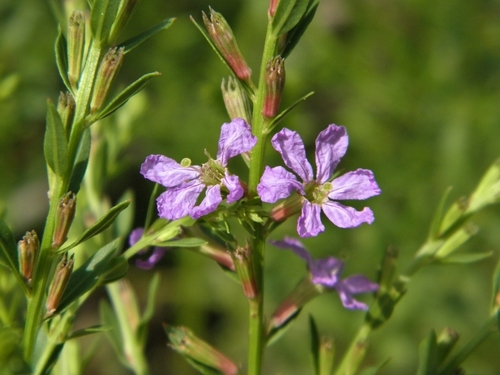


Winged Loosestrife
lythrum alatum
Winged Loosestrife (Lythrum alatum) is a lovely perennial wildflower native to wet prairies, marshes, and meadows across North America. Unlike its highly invasive relative, Purple Loosestrife, this native plant is well-behaved and integrates beautifully into wetland ecosystems without overtaking them. It produces charming, violet-purple flowers that line its upright stems, providing a vital nectar source for native bees, butterflies, and other pollinators during the peak of summer.
Hábitat: Typically found in wet prairies, sedge meadows, fens, marshes, and moist roadside ditches.
This herbaceous plant typically grows between 30 and 120 cm tall, featuring distinctly square stems with prominent wing-like ridges running down the angles. The narrow, lance-shaped leaves are arranged oppositely or alternately along the stems. During its summer blooming period, it produces small, solitary violet to pinkish-purple flowers, about 1 to 1.5 cm across, which emerge directly from the leaf axils.
Categoría
PlantasRareza
Common
Peligro
1/5 · Muy bajo
Snaps
¡Sé la primera persona en hacer un snap!
The flowers of this species are distylous, meaning they have two different anatomical forms that prevent self-fertilization, ensuring genetic diversity through insect-mediated cross-pollination.
The specific epithet 'alatum' is Latin for 'winged', referring directly to the prominent flat ridges that run along its square stems.
Unlike its invasive European relative, Purple Loosestrife, the native Winged Loosestrife grows in scattered, non-aggressive clusters and does not choke out native wetland biodiversity.
Possesses prominent raised angles or wings on its square stems that provide structural reinforcement against wind and rain in open wetland habitats.
Equipped with specialized root tissues that can withstand prolonged periods of soil waterlogging and oxygen deprivation.
Employs a reproductive system with two distinct flower morphs (different style and stamen lengths) to actively encourage cross-pollination by insects.
As a photosynthetic plant, Winged Loosestrife manufactures its own organic compounds using sunlight, water, and carbon dioxide, supplemented by minerals absorbed through its roots.
Bombus pensylvanicus
Provides rich nectar and pollen to this native bumblebee species, aiding in pollination.
Lythrum salicaria
Competes directly for space, nutrients, and pollinator attention in shared wetland habitats.
Galerucella calmariensis
This introduced biocontrol beetle occasionally feeds on the foliage of native winged loosestrife.
Aún no hay insignias de rasgos asignadas a este objeto.
Todavía no hay alias listados.
Las colecciones para este objeto aparecerán aquí a medida que se añadan más temas.
Peligro
1/5 · Muy bajo
Todavía no hay notas especiales de seguridad.
La forma más fácil de identificar a Winged Loosestrife es usar la aplicación de identificación de naturaleza Snappit.
30-120 cm
3-10 años
As a photosynthetic plant, Winged Loosestrife manufactures its own organic compounds using sunlight, water, and carbon dioxide, supplemented by minerals absorbed through its roots.
Typically found in wet prairies, sedge meadows, fens, marshes, and moist roadside ditches.
Acércate para separar los grupos y explorar dónde se ha fotografiado este objeto.
Los snaps recientes aparecerán aquí a medida que se añadan nuevas observaciones.








_-_Flickr_-_Jay_Sturner_(2).jpg&width=800)



