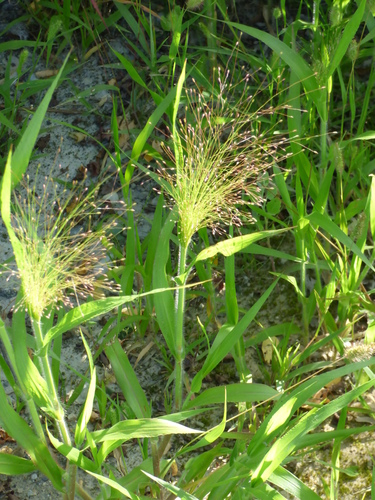


Witch Grass
panicum capillare
Witch grass (Panicum capillare), also known as tumbleweed grass, is a native North American annual grass known for its delicate, airy panicles that resemble green-to-purple clouds in late summer. As the plant matures, these large, highly branched seed heads break off at the base and roll across the landscape with the wind, effectively scattering seeds over vast distances. This unique tumbleweed mechanism makes it highly successful in colonizing disturbed soils, agricultural fields, and roadsides.
Hábitat: Found in disturbed areas, agricultural fields, roadsides, and sandy soils, often thriving in full sunlight.
Witch grass typically grows as an upright, tufted bunchgrass reaching heights of 20 to 80 cm. Its stems and leaf sheaths are distinctively covered in dense, spreading, stiff hairs, giving the plant a fuzzy texture. The leaf blades are flat, pale green, and up to 25 cm long. Its most identifying feature is its diffuse, highly branched, pyramid-shaped panicle, which features tiny, single-flowered spikelets on long, hair-like stalks, creating a misty, cloud-like silhouette.
Categoría
PlantasRareza
Common
Peligro
1/5 · Muy bajo
Snaps
¡Sé la primera persona en hacer un snap!
Because its seeds are lightweight and buoyant, they are often easily dispersed by agricultural machinery and water runoff.
The entire seed head can detach and blow away like a tumbleweed, a dispersal strategy known as anemochory.
Witch grass gets its scientific species name 'capillare' from the Latin word for hair, describing its hair-like inflorescence branches.
The mature, dried seed head breaks off cleanly at the base and rolls with the wind, scattering thousands of seeds across wide areas.
Dense, stiff hairs on its stems and leaves trap a thin boundary layer of air, reducing water loss in hot, dry conditions.
It quickly germinates and grows in nutrient-poor, compacted, or recently disturbed soils where other plants struggle to establish.
Produces its own energy from sunlight, carbon dioxide, water, and soil minerals via photosynthesis.
Meleagris gallopavo
Forages on the ground for fallen witch grass seeds during autumn and winter.
Anthus pratensis
Feeds on the nutritious, tiny seeds dropped by the mature grass.
Sipha flava
Sucks sap from the leaves, sometimes using the grass as a secondary host.
Aún no hay insignias de rasgos asignadas a este objeto.
Todavía no hay alias listados.
Las colecciones para este objeto aparecerán aquí a medida que se añadan más temas.
Peligro
1/5 · Muy bajo
Todavía no hay notas especiales de seguridad.
La forma más fácil de identificar a Witch Grass es usar la aplicación de identificación de naturaleza Snappit.
20-80 cm
1 años
Produces its own energy from sunlight, carbon dioxide, water, and soil minerals via photosynthesis.
Found in disturbed areas, agricultural fields, roadsides, and sandy soils, often thriving in full sunlight.
Acércate para separar los grupos y explorar dónde se ha fotografiado este objeto.
Los snaps recientes aparecerán aquí a medida que se añadan nuevas observaciones.


















