

Woolly Beachheather
hudsonia tomentosa
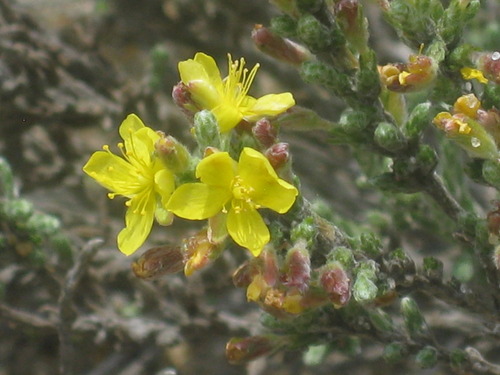
Woolly Beachheather (Hudsonia tomentosa) is a remarkable, resilient dwarf shrub that thrives in some of North America's most inhospitable environments: shifting sand dunes and barren pine plains. Belonging to the rockrose family (Cistaceae), this low-lying perennial forms expansive, moss-like mats that act as vital ecological anchors, binding loose sands with their extensive root networks and helping to stabilize fragile dune ecosystems against wind erosion. Despite its desert-like habitat, the plant remains evergreen, relying on specialized adaptations to conserve precious moisture. During most of the year, Woolly Beachheather blends quietly into the sandy landscape with its soft, silvery-gray foliage. However, in late spring, it undergoes a stunning transformation. The mats burst into a spectacular display of tiny, vibrant yellow flowers, creating a vivid contrast against the pale sands. These brief but beautiful blooms attract a variety of native pollinators, making this hardy pioneer species not only a crucial physical stabilizer of coastal and lakeside sands but also a vital resource for local biodiversity.
Hábitat: Found in coastal and inland sand dunes, sandy beaches, and pine barrens, where soils are nutrient-poor and highly draining.
Woolly Beachheather is a low-growing, highly branched evergreen subshrub forming dense, carpet-like mats up to 30 cm tall. Its tiny, scale-like leaves are needle-like, overlapping closely along the stems, and are heavily covered in a dense, grayish-white coat of woolly hairs (tomentum) that give the entire plant a distinct dusty-green or silvery-gray appearance. In late spring to early summer, the mats transform as they become blanketed in small, bright yellow, five-petaled flowers that open only in direct sunlight.
Categoría
PlantasRareza
Common
Peligro
1/5 · Muy bajo
Snaps
¡Sé la primera persona en hacer un snap!
Despite its name and resemblance to true heathers, Woolly Beachheather actually belongs to the rockrose family (Cistaceae).
Its woolly hairs not only trap moisture but also act as natural sunscreen, reflecting harsh sunlight off the sand.
The plant's flowers open for only a few hours on sunny days, relying on a rapid pollination window.
The dense, woolly hairs covering the leaves trap a layer of humid air close to the plant's surface, drastically reducing water loss from transpiration.
Its extensive, fibrous root network anchors the plant in shifting sands, helping to stabilize dune structures while securing moisture from deep below.
The small yellow flowers open only under bright, direct sunlight to maximize pollination efficiency, closing rapidly on cloudy days or during the night.
As an autotrophic plant, Woolly Beachheather produces its own organic compounds through photosynthesis, utilizing sunlight, carbon dioxide, and water.
Ammophila breviligulata
Co-occurs in sand dune habitats, where both species work together to stabilize shifting sands and build dune structures.
Xylocopa virginica
Visits the small yellow flowers to forage for pollen and nectar, facilitating pollination for the beachheather.
Aún no hay insignias de rasgos asignadas a este objeto.
Todavía no hay alias listados.
Las colecciones para este objeto aparecerán aquí a medida que se añadan más temas.
Peligro
1/5 · Muy bajo
Todavía no hay notas especiales de seguridad.
La forma más fácil de identificar a Woolly Beachheather es usar la aplicación de identificación de naturaleza Snappit.
10-30 cm
10-30 años
As an autotrophic plant, Woolly Beachheather produces its own organic compounds through photosynthesis, utilizing sunlight, carbon dioxide, and water.
Found in coastal and inland sand dunes, sandy beaches, and pine barrens, where soils are nutrient-poor and highly draining.
Acércate para separar los grupos y explorar dónde se ha fotografiado este objeto.
Los snaps recientes aparecerán aquí a medida que se añadan nuevas observaciones.

Massachusetts, US
Puedes ver Gaviota Argéntea Americana y éider Común.
Ver guía →

New York, US
Puedes ver Gaviota Argéntea Americana, Brant y Gavión Atlántico.
Ver guía →

Massachusetts, US
Puedes ver Woolly Beachheather y Gaviota Argéntea Americana.
Ver guía →
Massachusetts, US
Puedes ver Gayuba, Cangrejo Violinista Del Barro y Pino Rígido.
Ver guía →