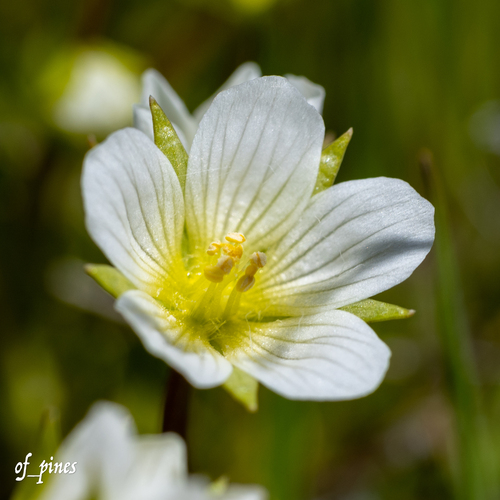


Woolly Meadowfoam
limnanthes pumila
The Woolly Meadowfoam (Limnanthes pumila) is a delicate, low-growing annual wildflower endemic to the unique, seasonally wet vernal pools and volcanic tablelands of Southern Oregon. This fascinating plant has evolved to thrive in an extreme, boom-or-bust ecosystem where soils are completely submerged during winter rains and baked bone-dry by the summer sun. Its survival hinges on a rapid spring lifecycle, transforming muddy pools into beautiful rings of white blooms before disappearing into dormancy as a seed.
Hábitat: Typically found in the ephemeral vernal pools and wet depressions of volcanic mounded prairies and tablelands.
This tiny herb rarely exceeds 10 centimeters in height. It is easily identified by its cup-shaped white flowers, which feature five petals with yellow bases, creating a delicate glowing center. True to its name, the calyx (the outer green sepals supporting the petals) is densely covered in fine, woolly white hairs. The leaves are deeply lobed and succulent, arranged in a low basal rosette that hugs the muddy ground.
Categoría
PlantasRareza
Common
Peligro
1/5 · Muy bajo
Snaps
¡Sé la primera persona en hacer un snap!
It is a strict endemic, meaning it is found naturally in only one small region on Earth—specifically around the Table Rocks of Southern Oregon.
Its seeds possess a durable dormancy mechanism that allows them to survive the baking summer heat of dry clay basins.
The dense 'woolly' hairs on its sepals help protect the developing flower buds from late-season frosts and retain moisture.
It successfully completes its entire life cycle within a short window, germinating underwater and flowering just as the pool dries.
The dense hairs on its sepals insulate the developing flower buds from frost during cold spring mornings and reduce water loss.
Its seeds enter a deep summer dormancy, allowing them to survive baking clay temperatures exceeding 40 degrees Celsius.
As a photoautotrophic plant, it produces its own energy through photosynthesis, utilizing sunlight, carbon dioxide, and water while absorbing mineral nutrients from the shallow vernal pool soils.
Andrena limnanthis
Specialist solitary bees visit the flowers for nectar and pollen, acting as primary pollinators.
Taeniatherum caput-medusae
Invasive annual grasses compete heavily for space, water, and nutrients in its fragile vernal pool habitat.
Aún no hay insignias de rasgos asignadas a este objeto.
Todavía no hay alias listados.
Las colecciones para este objeto aparecerán aquí a medida que se añadan más temas.
Peligro
1/5 · Muy bajo
Todavía no hay notas especiales de seguridad.
La forma más fácil de identificar a Woolly Meadowfoam es usar la aplicación de identificación de naturaleza Snappit.
2-10 cm
0.001-0.01 kg
1 años
As a photoautotrophic plant, it produces its own energy through photosynthesis, utilizing sunlight, carbon dioxide, and water while absorbing mineral nutrients from the shallow vernal pool soils.
Typically found in the ephemeral vernal pools and wet depressions of volcanic mounded prairies and tablelands.
Acércate para separar los grupos y explorar dónde se ha fotografiado este objeto.
Los snaps recientes aparecerán aquí a medida que se añadan nuevas observaciones.



















