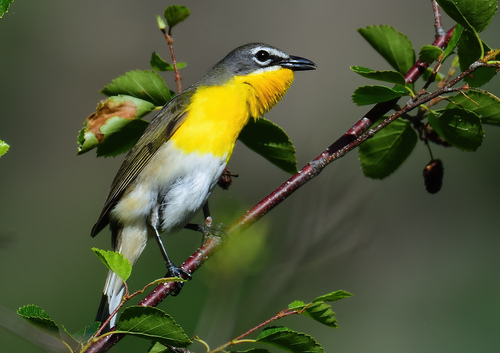


Yellow-Breasted Chat
icteria virens
The Yellow-breasted Chat is a charismatic and enigmatic songbird, renowned for its loud, idiosyncratic repertoire of clicks, whistles, clucks, and hoots. Once classified as the largest of the New World warblers, recent genetic studies have revealed it to be so distinctly different that it was placed into its very own family, Icteriidae. They are notorious for being heard rather than seen, often hiding deep within impenetrable tangles of shrubs, briars, and vines. However, during the spring breeding season, males drop their secretive behavior to launch into the air for a quirky, leg-dangling display flight while singing vigorously to attract mates. Their vibrant plumage, eccentric vocalizations, and secretive nature make catching a glimpse of a Yellow-breasted Chat a highly rewarding experience for any birdwatcher.
Hábitat: Typically found in dense, brushy thickets, briar tangles, shrubby clearings, and overgrown riparian areas where foliage is thick and impenetrable.
The Yellow-breasted Chat is a robust, heavy-billed songbird with striking, contrasting plumage. It features a bright, lemon-yellow throat and breast that cuts off sharply against a white lower belly and undertail coverts. Its upperparts are a solid, unmarked olive-green. The bird's face is distinctively patterned with sharp white "spectacles"—complete white eye-rings connected to white stripes above the lores—set against dark grayish or blackish cheek patches. They possess a relatively long tail, a thick, slightly curved blackish bill, and measure roughly 17 to 19 centimeters in length with a wingspan of about 23 to 27 centimeters.
Categoría
AvesRareza
Common
Peligro
1/5 · Muy bajo
Snaps
¡Sé la primera persona en hacer un snap!
For decades, scientists debated where to classify the Yellow-breasted Chat. In 2017, DNA testing finally proved it wasn't a true warbler, earning it its very own taxonomic family, Icteriidae.
The male's song is so varied and strange that early naturalists often compared it to the sounds of laughing, barking dogs, or squeaky mechanical gears.
They are expert ventriloquists; when calling from deep within a thicket, they can project their song to make it sound as if it's coming from a completely different direction.
Males produce a bizarre, disjointed series of hoots, whistles, chucks, and clucks, and are capable of mimicking the calls of other bird species.
During courtship, males launch into the air, puff out their chest feathers, and slowly descend with their legs dangling and wings clapping loudly.
Unlike most diurnal songbirds, male chats will often sing enthusiastically in the middle of the night during the spring breeding season to establish territory.
They feed primarily on small invertebrates during the breeding season and shift to a diet rich in wild fruits and berries in late summer and fall.
Diferencias por edad: Nestlings are fed almost exclusively soft-bodied insects and larvae for high protein, transitioning to include fruits as they fledge and mature.
Molothrus ater
The Brown-headed Cowbird frequently lays its eggs in the nests of Yellow-breasted Chats, leaving the chats to unknowingly raise cowbird chicks.
Accipiter cooperii
Fast-flying forest hawks like the Cooper's Hawk prey on adult and juvenile chats when they venture out of dense cover.
Rubus allegheniensis
The chat heavily consumes wild blackberries during the late summer, acting as an important vector for seed dispersal.
Aún no hay insignias de rasgos asignadas a este objeto.
Todavía no hay alias listados.
Las colecciones para este objeto aparecerán aquí a medida que se añadan más temas.
Peligro
1/5 · Muy bajo
Todavía no hay notas especiales de seguridad.
La forma más fácil de identificar a Yellow-Breasted Chat es usar la aplicación de identificación de naturaleza Snappit.
17-19 cm
23-27 cm
0.02-0.033 kg
5-8 años
40 km/h
They feed primarily on small invertebrates during the breeding season and shift to a diet rich in wild fruits and berries in late summer and fall.
Typically found in dense, brushy thickets, briar tangles, shrubby clearings, and overgrown riparian areas where foliage is thick and impenetrable.
Acércate para separar los grupos y explorar dónde se ha fotografiado este objeto.
Los snaps recientes aparecerán aquí a medida que se añadan nuevas observaciones.