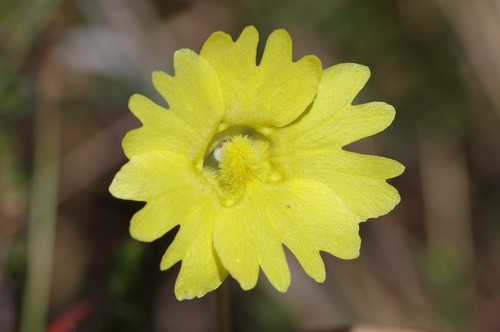


Yellow Butterwort
pinguicula lutea
The Yellow Butterwort (Pinguicula lutea) is an enchanting carnivorous plant native to the damp, acidic pine savannas of the southeastern United States. Emerging as a low-profile rosette of fleshy, yellow-green leaves, it employs a passive flypaper trapping mechanism to supplement its nutrient intake in poor soils. In spring, this unassuming plant transforms, sending up a slender, leafless stem topped with a brilliant, trumpet-shaped yellow flower that dances in the breeze. Beyond its vibrant floral display, the Yellow Butterwort is a master of survival. Its leaves are covered in thousands of microscopic glands that secrete a sticky, glistening glue. Unsuspecting insects are drawn to this shimmering trap, only to become hopelessly stuck, providing the plant with essential nitrogen and phosphorus. This elegant adaptation allows the yellow butterwort to thrive where other plants falter, making it a true marvel of the coastal plains.
Hábitat: Found in wet pine flatwoods, savannas, and acidic bogs across the southeastern United States.
The Yellow Butterwort is easily identified by its basal rosette of fleshy, oblong, yellow-green leaves that hug the ground, often measuring 5 to 15 cm in diameter. The leaves have distinctive slightly upturned, inward-curling margins and a greasy or sticky texture due to mucilage-secreting glands. From the center of this rosette, one to several hairy, leafless stalks grow 15 to 50 cm tall, each bearing a single, striking yellow flower. The flower features five deeply notched lobes with a yellow or slightly orange throat, creating a bright, trumpet-like appearance that sets it apart from other butterwort species.
Categoría
PlantasRareza
Common
Peligro
1/5 · Muy bajo
Snaps
¡Sé la primera persona en hacer un snap!
Historically, northern European cultures used related butterwort species to curdle milk into a yogurt-like substance called filmjolk.
The genus name Pinguicula comes from the Latin word pinguis, meaning fat or greasy, referencing the oily texture of its leaves.
The sticky mucilage on its leaves acts like a natural antibiotic, preventing the trapped insects from rotting before the plant can digest them.
The leaves are covered in specialized glandular trichomes that secrete a sticky fluid, acting like natural flypaper to capture tiny insects.
Sessile glands on the leaf surface release digestive enzymes, including proteases, to break down trapped prey directly on the leaf.
While largely stationary, the margins of the leaves can slowly curl inward when prey is captured, maximizing contact with digestive fluids.
Uses sticky leaves to trap and digest tiny soft-bodied insects to extract vital nutrients like nitrogen and phosphorus from nutrient-poor soil.
Diferencias por edad: Seedlings rely strictly on soil nutrients and tiny microbes until their leaves develop functional glandular hairs to capture insects.
Sarracenia flava
Grows alongside and competes for similar soil space and insect prey in wet pine savannas.
Lasioglossum lepidum
Relies on various small native bees for pollination to successfully reproduce.
Pinus palustris
Overstory tree that defines the fire-dependent savanna ecosystem necessary for the plant's survival.
Aún no hay insignias de rasgos asignadas a este objeto.
Todavía no hay alias listados.
Las colecciones para este objeto aparecerán aquí a medida que se añadan más temas.
Peligro
1/5 · Muy bajo
Todavía no hay notas especiales de seguridad.
La forma más fácil de identificar a Yellow Butterwort es usar la aplicación de identificación de naturaleza Snappit.
10-50 cm
0.005-0.02 kg
2-5 años
Uses sticky leaves to trap and digest tiny soft-bodied insects to extract vital nutrients like nitrogen and phosphorus from nutrient-poor soil.
Found in wet pine flatwoods, savannas, and acidic bogs across the southeastern United States.
Passive Trap
Acércate para separar los grupos y explorar dónde se ha fotografiado este objeto.
Los snaps recientes aparecerán aquí a medida que se añadan nuevas observaciones.













