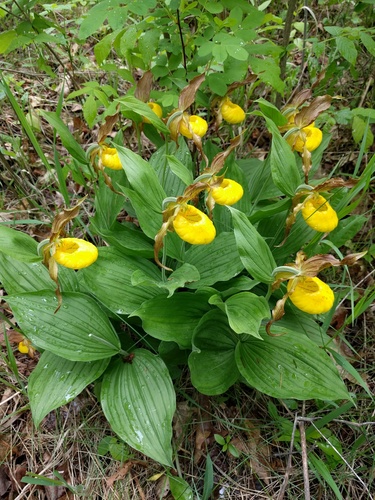


Yellow Lady'S Slipper
cypripedium parviflorum
The Yellow Lady's Slipper (Cypripedium parviflorum) is one of North America's most enchanting and recognizable wild orchids. Nestled in moist, dappled woodlands and fens, this perennial herb captivates hikers and botanists alike with its distinctive, pouch-like yellow flower that resembles a delicate slipper. It belongs to a primitive lineage of orchids and plays a fascinating role in its local ecosystems, relying on a complex web of interactions with soil fungi to survive and grow. Because of its beauty, the Yellow Lady's Slipper has historically faced pressure from wildflower collectors, making wild encounters with this resilient yet sensitive plant a highly prized experience. Observing one in its natural, untamed habitat is a true testament to the health and biodiversity of the surrounding wetland or forest.
Hábitat: Typically found in moist, deciduous or coniferous forests, fens, bogs, and calcareous swamps where the soil is rich, damp, and alkaline.
This striking orchid stands 15 to 80 cm tall, featuring alternate, deeply ribbed, bright green oval leaves that clasp the stem. Its most defining feature is the pouch-like golden-yellow lower petal (lip) measuring 2 to 5 cm long, which is flanked by spirally twisted, greenish-yellow to purplish-brown sepals and lateral petals. Small reddish-brown spots or streaks often decorate the interior of the yellow slipper, serving as guides for insect pollinators.
Categoría
PlantasRareza
Common
Peligro
1/5 · Muy bajo
Snaps
¡Sé la primera persona en hacer un snap!
It can take up to ten to twelve years of growth from a germinated seed before a Yellow Lady's Slipper plant produces its very first flower in the wild.
The seeds of the Yellow Lady's Slipper are so microscopic that they resemble fine dust, allowing them to easily travel on wind currents.
This orchid performs a 'scent trick' by emitting a fragrance that mimics the pheromones of specific bees, luring them into its trap without providing any sweet nectar.
The flower uses its pouch-like petal to temporarily trap insects, forcing them to crawl out of a specific exit path where they inevitably pick up or deposit pollen.
Its dust-like seeds lack a food reserve, relying entirely on a symbiotic relationship with mycorrhizal soil fungi to trigger germination and supply nutrients.
The stems and leaves are covered in fine, glandular hairs that secrete a substance capable of causing mild skin irritation in herbivores and humans, deterring foragers.
As a photosynthetic plant, it generates its own energy from sunlight, water, and carbon dioxide, while supplementing mineral intake through mycorrhizal fungi.
Diferencias por edad: As a seedling, it is non-photosynthetic and entirely heterotrophic, relying fully on mycorrhizal fungi for nutrients. Once mature, it develops leaves and becomes primarily photoautotrophic.
Tulasnella calospora
Forms a crucial mutualistic relationship with soil fungi, which sustain the orchid's seeds and root system with water and minerals.
Andrena carlini
Bees enter the slippery pouch seeking nectar, and while trying to escape, they get coated in sticky pollen, facilitating cross-pollination.
Aún no hay insignias de rasgos asignadas a este objeto.
Todavía no hay alias listados.
Las colecciones para este objeto aparecerán aquí a medida que se añadan más temas.
Peligro
1/5 · Muy bajo
Todavía no hay notas especiales de seguridad.
La forma más fácil de identificar a Yellow Lady'S Slipper es usar la aplicación de identificación de naturaleza Snappit.
15+ cm
As a photosynthetic plant, it generates its own energy from sunlight, water, and carbon dioxide, while supplementing mineral intake through mycorrhizal fungi.
Typically found in moist, deciduous or coniferous forests, fens, bogs, and calcareous swamps where the soil is rich, damp, and alkaline.
Acércate para separar los grupos y explorar dónde se ha fotografiado este objeto.
Los snaps recientes aparecerán aquí a medida que se añadan nuevas observaciones.

Michigan, US
Puedes ver Yellow Lady's Slipper, Gaviota De Delaware y Tuya Occidental.
Ver guía →

Michigan, US
Puedes ver Yellow Lady's Slipper, Tuya Occidental y Gaviota De Delaware.
Ver guía →
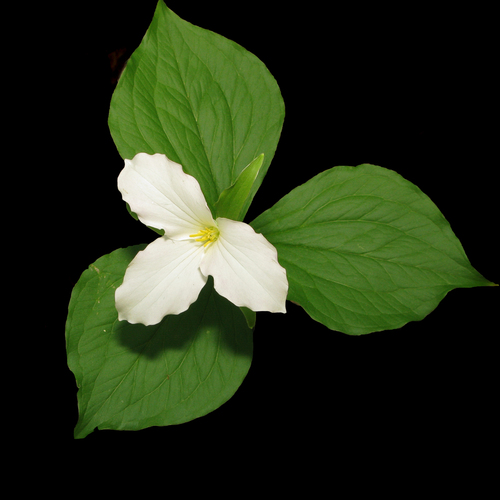
Virginia, US
Puedes ver Trillium Blanco Grande, Geranio Silvestre y Anémona Ruda.
Ver guía →

Michigan, US
Puedes ver Yellow Lady's Slipper, Tuya Occidental y Gaviota De Delaware.
Ver guía →












