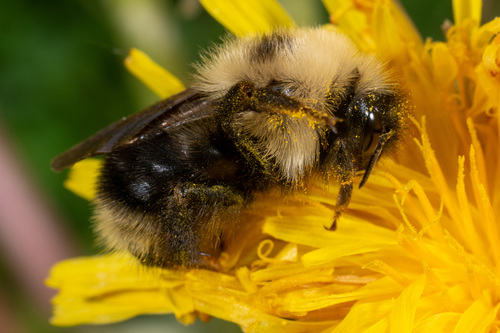


Yellowish Cuckoo Bumble Bee
bombus flavidus
The Yellowish Cuckoo Bumble Bee (Bombus flavidus) is a fascinating and stealthy inhabitant of boreal and montane ecosystems. Unlike typical bumble bees that laboriously gather pollen to provision their nests, this species lives as an obligate social parasite, or 'cuckoo.' Females are specialized infiltrators that seek out the established colonies of other bumble bee species, relying on the host workers to rear their young. This unique lifestyle completely bypasses the need to build a nest or forage for larval food, highlighting a remarkable evolutionary divergence within the bee world. Because of their reliance on host populations, the presence of the Yellowish Cuckoo Bumble Bee is a strong indicator of a healthy, thriving ecosystem capable of supporting diverse bee communities. Their distinct behaviors and life cycle make them a captivating subject for both casual observers and entomologists.
Hábitat: Found in boreal forests, taiga, and high-elevation alpine meadows, strictly following the distribution of its specific bumble bee host species.
Bombus flavidus can be distinguished from non-parasitic bumble bees primarily by the distinct lack of corbiculae (pollen baskets) on the hind legs of females; instead, their hind legs are rounded, convex, and densely hairy. They generally feature a relatively shaggy coat of pale yellowish hair on the thorax and abdomen, often interrupted by a darker band of black hairs between the wings and on the face. Their bodies appear slightly more robust with a thicker, harder exoskeleton, which serves as armor, and their wings often have a subtle dark tint. They lack the characteristic worker caste, so any encountered individual will either be a large reproductive female or a male.
Categoría
InsectosRareza
Common
Peligro
1/5 · Muy bajo
Snaps
¡Sé la primera persona en hacer un snap!
Because they never need to collect food for their young, female cuckoo bumble bees completely lack the pollen baskets found on the legs of typical bumble bees.
Cuckoo bumble bees do not produce a worker caste; every egg laid by the intruding female is destined to become a reproductive male or a new queen.
To survive the hostile takeover of a colony, they have evolved heavily armored exoskeletons that protect them from the stings of defending workers.
When sneaking into a host nest, a female may hide in the nest debris for days, absorbing the colony's unique scent to avoid being attacked.
Females take over the nests of other bumble bee species, subjugating or killing the resident queen and forcing host workers to raise her offspring.
Possesses an exceptionally thick and hardened cuticle designed to protect the bee from stings and bites during hostile nest takeovers.
Capable of mimicking the specific pheromonal scent of the host colony to avoid detection and reduce aggression from defending workers.
Adults sustain themselves purely on flower nectar for energy, while their larvae are fed a mixture of nectar and pollen gathered entirely by the workers of their host colony.
Diferencias por edad: Larvae consume a protein-rich diet of pollen and nectar provided by host workers, whereas adults consume strictly nectar for immediate flight energy.
Bombus occidentalis
Infiltrates nests to use workers for rearing offspring.
Chamerion angustifolium
Adults forage on nectar, providing incidental pollination.
Misumena vatia
Ambushed and eaten while foraging on flowers.
Aún no hay insignias de rasgos asignadas a este objeto.
Todavía no hay alias listados.
Las colecciones para este objeto aparecerán aquí a medida que se añadan más temas.
Peligro
1/5 · Muy bajo
Todavía no hay notas especiales de seguridad.
La forma más fácil de identificar a Yellowish Cuckoo Bumble Bee es usar la aplicación de identificación de naturaleza Snappit.
1-2 cm
2-4 cm
0.0001-0.0004 kg
0-1 años
15 km/h
Adults sustain themselves purely on flower nectar for energy, while their larvae are fed a mixture of nectar and pollen gathered entirely by the workers of their host colony.
Found in boreal forests, taiga, and high-elevation alpine meadows, strictly following the distribution of its specific bumble bee host species.
Acércate para separar los grupos y explorar dónde se ha fotografiado este objeto.
Los snaps recientes aparecerán aquí a medida que se añadan nuevas observaciones.


















