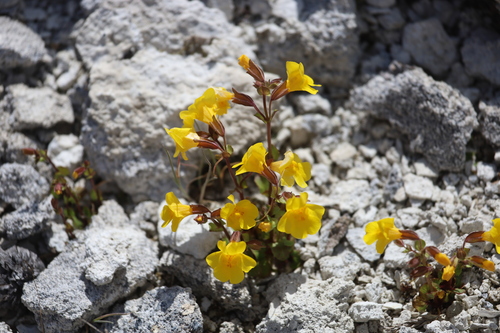


Yellowstone Monkeyflower
erythranthe thermalis
The Yellowstone Monkeyflower (Erythranthe thermalis) is a remarkable, tiny annual plant specifically adapted to one of the most extreme environments on Earth: the geothermally heated soils of Yellowstone National Park. Thriving on the margins of boiling hot springs, fumaroles, and geyser runoff channels, this extremophile adds vibrant splashes of bright yellow to otherwise barren, steaming landscapes. Because the thermal soils become lethally hot and dry as summer progresses, it completes a rapid life cycle, blooming brilliantly in late spring and early summer before perishing. Its ability to survive root-zone temperatures that would easily kill most other vegetation makes it a fascinating subject of study in plant thermal tolerance and evolution.
Hábitat: Found exclusively on the moist, geothermally heated soils along the margins of hot springs, geysers, and thermal run-offs.
This diminutive plant typically reaches only 2 to 10 centimeters in height, exhibiting a compact, dwarfed growth habit. It features opposite, somewhat rounded to oval leaves that are light green, sometimes tinged with red or purple due to environmental stress. The blooms are classic monkeyflower shapes: small, tubular, and strongly two-lipped (bilabiate). The petals are a vibrant, cheerful yellow, usually marked with distinct reddish-brown or crimson spots in the lower throat, which serve as nectar guides for insect pollinators.
Categoría
PlantasRareza
Common
Peligro
1/5 · Muy bajo
Snaps
¡Sé la primera persona en hacer un snap!
Because it is entirely dependent on Yellowstone's hydrothermal features, a shift in the park's subterranean geyser activity could completely alter or eliminate a local population overnight.
Its name 'monkeyflower' comes from the shape of its blooms, which some say resemble a smiling monkey's face when squeezed gently.
The Yellowstone Monkeyflower thrives in soils that can reach 45°C (113°F)—temperatures that would literally cook the roots of a normal houseplant.
To survive the extreme heat, millions of these tiny plants bloom in a synchronized rush before the late summer sun completely bakes their habitat.
Capable of surviving and thriving in heated soils reaching up to 45°C (113°F) where most other plants would perish.
Completes its entire life cycle from germination to seed production in just a few weeks to avoid peak summer heat and drought.
Maintains a highly compact, miniaturized size to minimize exposure to hot ambient air and conserve water in its harsh microclimate.
As a photosynthetic plant, it produces its own energy using sunlight, water, and atmospheric gases.
Bombus occidentalis
Pollinated by small bees seeking nectar in the thermal basins.
Dichanthelium lanuginosum
Shares its extreme thermal habitat with other specialized extremophile plants.
Urocitellus armatus
Provides brief seasonal forage for small herbivores living near thermal features.
Aún no hay insignias de rasgos asignadas a este objeto.
Todavía no hay alias listados.
Las colecciones para este objeto aparecerán aquí a medida que se añadan más temas.
Peligro
1/5 · Muy bajo
Todavía no hay notas especiales de seguridad.
La forma más fácil de identificar a Yellowstone Monkeyflower es usar la aplicación de identificación de naturaleza Snappit.
2-10 cm
0 años
As a photosynthetic plant, it produces its own energy using sunlight, water, and atmospheric gases.
Found exclusively on the moist, geothermally heated soils along the margins of hot springs, geysers, and thermal run-offs.
Photosynthesis
20-150
5-14 días
Acércate para separar los grupos y explorar dónde se ha fotografiado este objeto.
Los snaps recientes aparecerán aquí a medida que se añadan nuevas observaciones.




















