
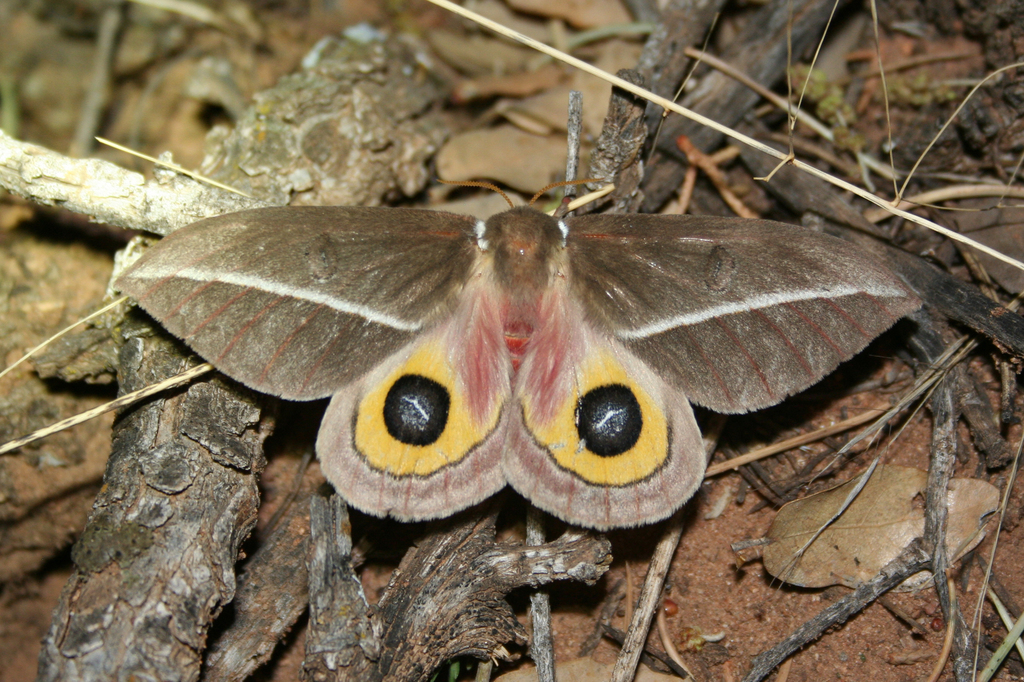





Zephyr Eyed Silkmoth
Automeris zephyria
The Zephyr Eyed Silkmoth is a beautiful moth with big, colorful eyes on its wings. These eyes help scare away predators! They are mostly active at night and love to flutter around gardens.
Hábitat: Forests
The Zephyr Eyed Silkmoth has broad wings, typically yellowish to reddish-brown, often with faint lines. Its most striking feature is the pair of large, vivid eyespots on its hindwings, which are black with a blue or white center and often rimmed with red. Its body is robust and covered in dense, soft hairs.
Categoría
InsectosRareza
Common
Peligro
1/5 · Muy bajo
Snaps
¡Sé la primera persona en hacer un snap!
Adult silkmoths live for only a few days; their main goal is to find a mate!
Before becoming a moth, its caterpillar spins a strong, silk cocoon for protection!
It belongs to the 'Giant Silkmoth' family, known for making huge, beautiful cocoons!
Its caterpillars are often brightly colored with spines, warning predators not to touch them!
Zephyr Eyed Silkmoth can flash its hindwings to reveal large, fake eyes because this sudden display can startle predators away.
Zephyr Eyed Silkmoth has forewings that blend with tree bark, helping them hide perfectly during the day.
Zephyr Eyed Silkmoth can fly at night, guided by moonlight and scents, to find mates and avoid daytime predators.
Adult moths do not eat; caterpillars munch on tree and shrub leaves.
Diferencias por edad: Adult moths do not feed, relying on energy stored from their caterpillar stage. Caterpillars are voracious leaf-eaters.
Bubo virginianus
Nocturnal owl preys on adult moths.
Archytas analis
Lays eggs on caterpillars, which are then eaten from inside.

Quercus virginiana
Caterpillars feed on its leaves for growth.
Salix nigra
Caterpillars feed on its leaves for growth.
Peludo describe a los animales que poseen una cubierta densa de pelo o pelaje suave.
Los animales solitarios viven solos durante la mayor parte de su vida y solo interactúan con otros para aparearse o cuidar de sus crías.
Colorido describe a organismos u objetos que exhiben una amplia variedad de colores brillantes y distintivos.
Este rasgo caracteriza a los organismos cuya dieta consiste total o principalmente en material vegetal.

Describe plantas que son particularmente atractivas y beneficiosas para una amplia variedad de organismos polinizadores.

Los hábitats boscosos son entornos terrestres dominados por una densa cubierta arbórea, que sustentan una gran diversidad de vida animal y vegetal.

Los animales nocturnos están principalmente activos durante la noche, y suelen descansar o dormir durante el día.

Describe organismos que transfieren polen, permitiendo la fertilización y reproducción de las plantas.
Todavía no hay alias listados.
Peligro
1/5 · Muy bajo
Always watch moths from a distance and don't try to catch them.
50-100 mm
25-45 mm
5-14 días
15 km/h
Adult moths do not eat; caterpillars munch on tree and shrub leaves.
Forests
6
Acércate para separar los grupos y explorar dónde se ha fotografiado este objeto.
Los snaps recientes aparecerán aquí a medida que se añadan nuevas observaciones.













