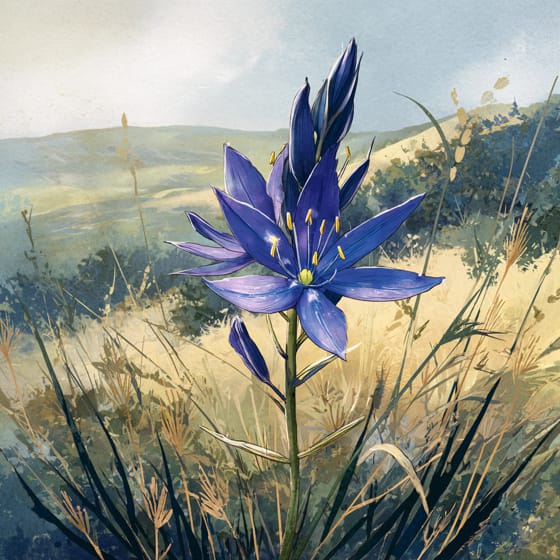





Camassia
Camassia
Camassia flowers are pretty and grow in clusters. They are often found in meadows and are loved by pollinators!
Habitat: Camassias like to grow in wet meadows and gardens.
The Camassia has tall, slender stalks topped with striking star-shaped flowers in shades of vibrant blue, purple, or creamy white. Its narrow, grass-like leaves emerge from a bulb, creating a distinct upright appearance. The blossoms form a showy spike, making it visually stand out in meadows.
Category
PlantsRarity
Common
Danger
1/5 · Very low
Snaps
Be the first to snap!
Despite its beauty, beware: other similar plants like Death Camas are extremely poisonous!
Indigenous peoples traditionally baked Camassia bulbs in earthen ovens for food.
Its bulbs were a vital food source for explorers like Lewis and Clark on their expeditions.
Some Camassia species bloom so densely they create stunning blue 'carpets' across meadows!
Camassia has a starchy underground bulb that helps it store energy and nutrients to survive winter and sprout reliably each spring.
Camassia produces nectar-rich flowers in vibrant hues that attract various bees and other insects, ensuring successful pollination.
Camassia can go dormant underground during hot, dry summers, allowing it to conserve water and energy until conditions improve.
Apis mellifera
Gathers nectar and pollen from the flowers.
Bombus vosnesenskii
Visits Camassia flowers, aiding in reproduction.
.jpg&width=800)
Microtus californicus
Volves may dig up and eat Camassia bulbs.
Ursus americanus
Bears occasionally consume Camassia bulbs.
Cluster flowers are inflorescences where individual flowers are arranged closely together on a common stem.
Spring blooming plants produce their flowers during the spring season, often signifying the end of winter and the start of new growth.
This habitat trait identifies species found in wetlands, which are areas of land saturated with water, either permanently or seasonally, including marshes, swamps, and bogs.
Danger
1/5 · Very low
Explore with care and ask an adult if you’re unsure what to do.
The easiest way to identify Camassia is to use the Snappit nature identifier app.
30-90 cm
15-30 cm
2-4 cm
Late spring to early summer
Yes
Mild
Perennial
Zoom in to split clusters and explore where this object has been snapped.
Recent snaps will appear here as new observations are added.
Take the discovery with you
Snap it with Snappit to identify it, learn what makes it special, and add the discovery to your collection.








.jpg&width=800)



_001.jpg&width=800)




