





Cedar
Cedrus
Cedar trees are tall evergreens with fragrant wood. They have cones instead of flowers and provide shelter for many animals in the forest.
Habitat: Forests
The Cedar is a majestic evergreen tree, often with a broad, conical crown and distinct horizontal branches. It has short, stiff, needle-like leaves, typically blue-green or dark green, grouped in dense clusters. Its unique barrel-shaped cones stand upright on the branches.
Category
TreesRarity
Common
Danger
1/5 · Very low
Snaps
Be the first to snap!
Ancient pharaohs used cedar wood to build grand temples and ships!
Cedar cones are unique because they grow upright like tiny barrels on the branches!
Cedar wood has a naturally sweet, aromatic smell that helps keep insects away.
The famous 'Cedars of God' forest in Lebanon has trees thousands of years old!
Cedar has tough, waxy needles that help it photosynthesize all year, even in cold weather, to survive and grow.
Cedar can produce natural oils that make its wood resistant to rot and insects, helping it defend against decay.
Cedar has strong, deep root systems that help it anchor firmly to steep or rocky slopes, allowing it to survive challenging terrains.
.jpg&width=800)
Loxia curvirostra
Cracks open cedar cones to extract nutritious seeds.
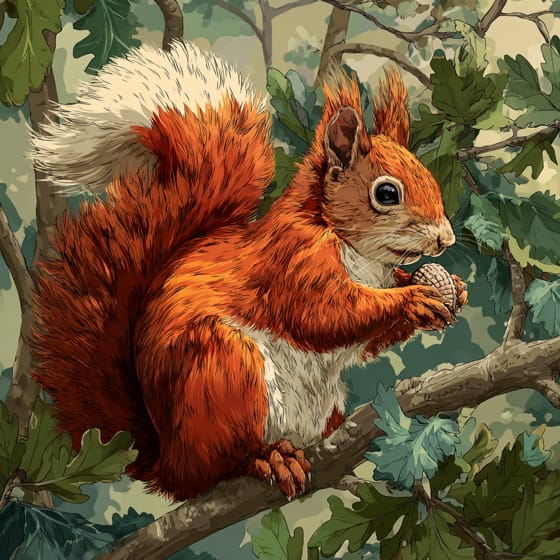
Sciurus vulgaris
Builds nests in cedar branches for protection and eats seeds.
Rhizopogon roseolus
Exchanges vital nutrients with cedar roots to aid growth.
Shade tolerant plants are adapted to grow and thrive in areas with low light levels, requiring less direct sunlight.
Coniferous plants are typically evergreen, bearing needles or scales and reproductive cones.
Evergreen plants retain their foliage throughout the year, never shedding all their leaves at once.
Fragrant flowers emit a pleasant aroma, often to attract pollinators or for defense.

Timber refers to wood that has been prepared for use in building and carpentry.

Forest habitats are terrestrial environments dominated by dense tree cover, supporting a high diversity of plant and animal life.

This trait characterizes organisms with an exceptionally long lifespan compared to others of their kind.
Danger
1/5 · Very low
Enjoy looking at cedar trees from a safe distance and avoid climbing them.
The easiest way to identify Cedar is to use the Snappit nature identifier app.
20-50 m
10-20 m
No
100-300 cm
100-1000 years
Forests
Cone
Zoom in to split clusters and explore where this object has been snapped.
Recent snaps will appear here as new observations are added.
Take the discovery with you
Snap it with Snappit to identify it, learn what makes it special, and add the discovery to your collection.











