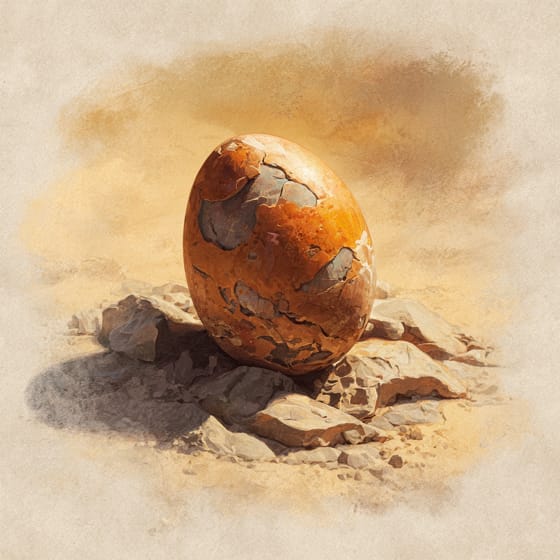





Dinosaur Egg Fossil
A dinosaur egg fossil is a hard shell that held a baby dinosaur inside! It shows us how dinosaurs started their lives.
The Dinosaur Egg Fossil is typically a rounded or oval stony object, often brownish, grey, or reddish in color. Its surface can be smooth, textured, or even show cracks, sometimes revealing internal rock formations or even bone fragments.
Category
AncientRarity
Legendary
Danger
1/5 · Very low
Snaps
Be the first to snap!
Dinosaur eggs came in many shapes, from perfect spheres to elongated ovals!
Scientists can learn about dinosaur social life from how eggs are grouped!
Some fossilized dinosaur eggs still have tiny fossilized baby bones inside!
The smallest dinosaur egg ever found was only about an inch long!
Dinosaur Egg Fossil can reveal ancient environments and climates because it preserves clues about the past.
Dinosaur Egg Fossil has preserved embryos that help scientists understand how dinosaurs grew and developed before hatching.
Dinosaur Egg Fossil can indicate ancient nesting sites because discovering them often points to dinosaur breeding grounds.
Dinosaur Egg Fossil has unique shell structures that help paleontologists identify the specific dinosaur species that laid it.
As a fossil, it doesn't eat; it's a preserved relic from ancient times.
Colorful describes organisms or objects displaying a wide range of bright and distinct colors.
Ancient refers to organisms, objects, or geological formations that have existed for an extremely long period.
An artifact is an object made or modified by human culture, typically of historical or archaeological interest.
No aliases listed yet.
Danger
1/5 · Very low
Explore with care and ask an adult if you're unsure what to do.
The easiest way to identify Dinosaur Egg Fossil is to use the Snappit nature identifier app.
0.05-0.6 m
0.001-10 kg
As a fossil, it doesn't eat; it's a preserved relic from ancient times.
Mesozoic
66
Zoom in to split clusters and explore where this object has been snapped.
Recent snaps will appear here as new observations are added.
Take the discovery with you
Snap it with Snappit to identify it, learn what makes it special, and add the discovery to your collection.