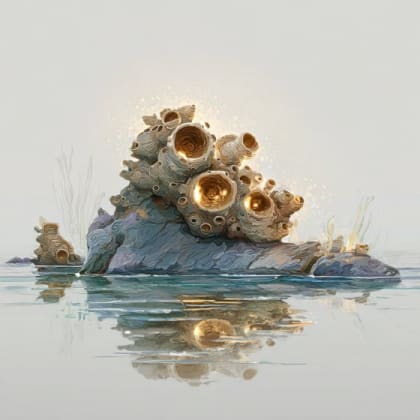
Limpet
Acmaea
Limpets are small sea creatures with cone-shaped shells that stick tightly to rocks along the shore. They use their strong muscular foot to cling on and protect themselves from waves and predators.
Habitat: Coastal areas
The Limpet has a distinctive conical or cap-shaped shell, often dull grey, brown, or greenish, blending with rocky surfaces. Its shell is smooth or ribbed, and it uses a strong, muscular foot to cling tightly to rocks. It looks like a tiny, living volcano.
Category
InvertebrateRarity
Common
Danger
1/5 · Very low
Snaps
Be the first to snap!
Limpets can withstand massive wave forces, surviving extreme oceanic conditions.
Limpets return to a special 'home scar' on rocks after foraging, fitting perfectly!
Their teeth are the strongest known biological material on Earth, even stronger than Kevlar!
They breathe using gills located in a special cavity under their shell, staying moist.
Limpet can cling incredibly tightly because of its powerful muscular foot, which creates suction against rocks.
Limpet has a radula (a ribbon-like tongue) covered in iron-hard teeth that helps them scrape algae off rocks.
Limpet has a tough shell that protects them from predators and prevents drying out during low tide.
Limpets are algae eaters, scraping tiny plants off rocks with their strong teeth.
Pisaster ochraceus
A common predator that pries limpets off rocks.

Haematopus ostralegus
This bird uses its strong beak to dislodge and eat limpets.
Navicula pelliculosa
Limpets graze on microscopic diatoms covering rock surfaces.
Wildlife encompasses all undomesticated animal and plant life existing in their natural habitats.
Solitary animals live alone for most of their lives, only interacting with others for mating or parental care.
Camouflaged describes organisms that possess coloring or patterns that allow them to blend into their environment.
Filter feeders obtain nutrients by straining suspended food particles and small organisms from water.

This trait characterizes organisms whose diet consists entirely or primarily of plant material.

This trait characterizes organisms with an exceptionally long lifespan compared to others of their kind.

Coastal habitats are dynamic environments located along the interface between land and sea, influenced by tides, waves, and saltwater.
Danger
1/5 · Very low
If you see limpets on rocks, it's best not to disturb them as they are important for the coastal ecosystem.
The easiest way to identify Limpet is to use the Snappit nature identifier app.
4.5 cm
20 g
10 years
Limpets are algae eaters, scraping tiny plants off rocks with their strong teeth.
Coastal areas
Grazing
Zoom in to split clusters and explore where this object has been snapped.
Recent snaps will appear here as new observations are added.
Take the discovery with you
Snap it with Snappit to identify it, learn what makes it special, and add the discovery to your collection.