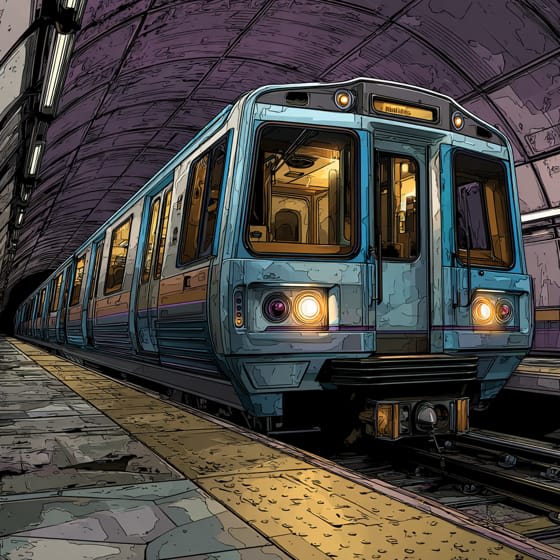





Metro Subway Train
The Metro Subway Train zooms underground to take people where they need to go! It's a fast and exciting way to travel beneath the city.
The Metro Subway Train is a sleek, multi-car vehicle often seen in urban tunnels or on elevated tracks. It typically has a streamlined front car and often features metallic or painted exteriors with bold stripes, making it look modern and efficient.
Category
VehiclesRarity
Common
Danger
1/5 · Very low
Snaps
Be the first to snap!
Many modern subway systems use computers to drive the trains, sometimes without any human driver!
Some metro lines go so deep underground, their stations are like hidden caves or art museums!
The deepest subway station in the world is Arsenalna in Kyiv, Ukraine, over 100 meters down!
The world's first underground railway opened in London in 1863, called the Metropolitan Railway!
Metro Subway Trains use powerful electric motors that let them glide smoothly and quietly through tunnels without polluting the air.
Advanced regenerative braking systems on Metro Subway Trains capture energy, letting them stop quickly and efficiently.
Its modular design allows for many connected cars, letting it transport thousands of passengers at once.
An urban fixture is a permanent or semi-permanent object installed in a public urban space for functional or aesthetic purposes.
Describes species that communicate significant information to others, often through signals or specialized behaviors.
Public transport refers to shared passenger services available to the general public, typically running on fixed routes and schedules.
Describes species exhibiting circular or wheel-like structures primarily used for movement or rotation.
Danger
1/5 · Very low
Explore with care and ask an adult if you’re unsure what to do.
The easiest way to identify Metro Subway Train is to use the Snappit nature identifier app.
120 m
240000 kg
90 km/h
Electricity
1200
Zoom in to split clusters and explore where this object has been snapped.
Recent snaps will appear here as new observations are added.
Take the discovery with you
Snap it with Snappit to identify it, learn what makes it special, and add the discovery to your collection.