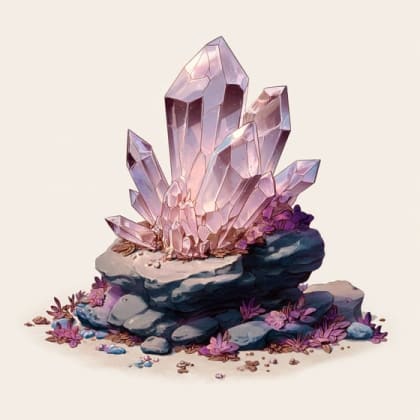




Opal
Opal is a colorful stone that sparkles with many colors, just like a rainbow! Each opal is unique.
The Opal is famous for its stunning 'play-of-color,' a rainbow flash of iridescent hues that shifts with light and angle. It often appears milky white, blue, or black, but can be found in almost any color, resembling a solidified rainbow. This unique visual effect makes it stand out from other gems.
Category
MineralRarity
Common
Danger
1/5 · Very low
Snaps
Be the first to snap!
Did you know NASA's Mars Reconnaissance Orbiter found opal deposits on the surface of Mars?
Opal is the national gemstone of Australia, which produces over 90% of the world's precious opals.
Some ancient cultures believed opals were formed when lightning bolts struck the Earth!
Unlike most gems, some opals can dry out and crack over time if not properly cared for!
Opal has microscopic silica spheres that diffract light, creating a dazzling 'play-of-color' that shifts like a living rainbow.
Opal is hydrated silica, meaning it contains water. This makes it surprisingly lighter than other gemstones of its size.
Fluorescent minerals emit visible light when exposed to ultraviolet light or other non-visible radiation, a phenomenon called fluorescence.
A gemstone is a piece of mineral crystal which, when cut and polished, is used to make jewelry or other adornments.
Crystalline describes a mineral or rock composed of crystals, often exhibiting a regular atomic structure and geometric external form.
Natural refers to organisms, materials, or phenomena existing or produced by nature, not artificially created.
Danger
1/5 · Very low
Handle gently and avoid sharp edges. Ask an adult before picking anything up.
The easiest way to identify Opal is to use the Snappit nature identifier app.
white, black, blue, green, red, orange, yellow, pink, brown, colorless, play-of-color
5.5
vitreous to waxy
2.1
Zoom in to split clusters and explore where this object has been snapped.
Recent snaps will appear here as new observations are added.
Take the discovery with you
Snap it with Snappit to identify it, learn what makes it special, and add the discovery to your collection.