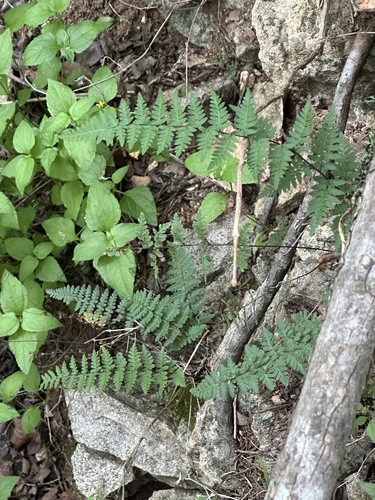


Alabamensis Clade
myriopteris alabamensis
The Alabama lip fern (Myriopteris alabamensis), representing the Alabamensis Clade, is a resilient and elegant perennial fern adapted to life on the edge. Flourishing in harsh, rocky environments, this plant clings to limestone cliffs, ledges, and outcroppings across the southern United States and northern Mexico. Unlike many moisture-loving ferns, it is a master of drought survival, capable of withstanding prolonged dry spells by curling its fronds and entering a dormant state until the rain returns. Its ability to colonize alkaline rocky crevices makes it a vital pioneer species in limestone glade ecosystems, showcasing the incredible adaptability of the Pteridaceae family.
生息地: Found primarily on dry to moist limestone cliffs, ledges, talus slopes, and rocky glades.
This fern features slender, upright fronds measuring 10 to 35 centimeters in length, arising from a short, creeping rhizome covered in narrow, dark brown scales. The fronds are lance-shaped, twice-pinnate, and present a deep, dusty green coloration. A key identifier is the dark, shiny, purplish-brown to black stipe which is sparsely lined with fine, pale hairs. The undersides of the pinnae are relatively smooth compared to other Myriopteris species, lacking dense woolly coverings but hosting delicate hairs along the midribs.
カテゴリ
植物レア度
Common
危険度
1/5 · 非常に低い
スナップ
最初にスナップしよう!
It is often called a resurrection fern because dry, seemingly dead fronds spring back to vibrant green life after a brief rain shower.
Its scientific name, Myriopteris, is derived from Greek words meaning myriad-winged, referring to its highly divided, delicate lace-like fronds.
Unlike many ferns that prefer acidic forest soils, the Alabamensis Clade thrives strictly on alkaline, calcium-rich limestone substrates.
The fern can lose up to ninety percent of its cellular water, curling into a dry brown ball, and rapidly unfurl and resume photosynthesis within hours of receiving moisture.
Its roots secrete mild organic acids that slowly dissolve limestone, allowing the fern to anchor securely in solid rock crevices and extract minerals.
It produces lightweight, aerodynamic spores designed to be carried by wind currents into narrow rocky fissures where larger seeds cannot lodge.
As a photosynthetic plant, it synthesizes its own food using sunlight, carbon dioxide, and water absorbed through its roots.
Anomodon attenuatus
Grows alongside the fern in rock crevices, helping to retain micro-moisture for germinating spores.
Anguispira alternata
Feeds on the organic detritus and decaying fronds of the fern on limestone faces.
このオブジェクトにはまだ特徴バッジが割り当てられていません。
テーマが追加されると、このオブジェクトのコレクションがここに表示されます。
危険度
1/5 · 非常に低い
まだ特別な安全上の注意はありません。
Alabamensis Cladeを識別する最も簡単な方法は、Snappit自然識別アプリを使用することです。
10-35 cm
3-15 年
As a photosynthetic plant, it synthesizes its own food using sunlight, carbon dioxide, and water absorbed through its roots.
Found primarily on dry to moist limestone cliffs, ledges, talus slopes, and rocky glades.
ズームインしてクラスターを分割し、このオブジェクトが撮影された場所を探索しましょう。
新しい観察が追加されると、ここに最近のスナップが表示されます。




.jpg&width=800)









