

Alpine Bladder-Fern
cystopteris alpina
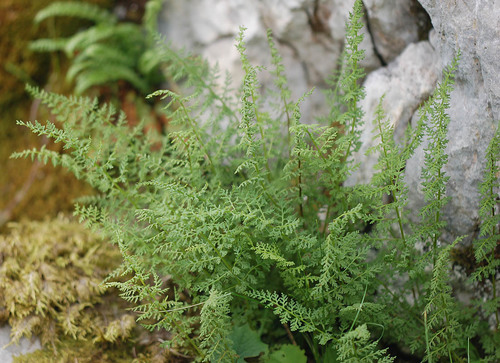
The Alpine Bladder-Fern (Cystopteris alpina) is a delicate, bright green perennial fern that brings life to harsh mountain landscapes. Thriving in the cracks of high-altitude limestone rocks and scree slopes, this resilient little fern is highly specialized for alpine environments. Its common name bladder-fern comes from the tiny, hood-like indusia that cover and protect its developing spore-producing structures, resembling small inflated bladders. This delicate shield is vital for safeguarding its offspring against the freezing winds and intense solar radiation of its montane homes. Hikers and plant enthusiasts often admire this fern for its finely dissected, lace-like fronds, which present a striking contrast against the rugged, barren grey rock faces where it anchors itself. As a true survivor of the high peaks, it plays a quiet but essential role in stabilizing loose rocky soils and fostering micro-habitats for mountain-dwelling micro-organisms.
生息地: Found exclusively in the damp, sheltered crevices of high-altitude limestone cliffs and calcareous scree slopes.
This small fern typically reaches 5 to 25 cm in height with highly divided, lace-like fronds that give it a delicate, airy appearance. The fronds are lance-shaped, exhibiting a bright green color when young that turns slightly darker at maturity. Its slender stalks are fragile and often display a dark reddish-brown hue at the base, transitioning to green or straw-yellow further up. The defining feature is the small, round spore cases on the leaf undersides, each shielded by a translucent, hood-like membrane that splits open when the spores are ready.
カテゴリ
植物レア度
Common
危険度
1/5 · 非常に低い
スナップ
最初にスナップしよう!
Despite their fragile, paper-thin appearance, the fronds of the Alpine Bladder-Fern are highly frost-tolerant and can handle sudden summer snowfalls with ease.
The common name 'bladder-fern' refers to the tiny hood-like membrane covering the spores, which swells up and looks like a miniature bubble or bladder.
This species is a strict calciphile, meaning it is biologically bound to limestone and other calcium-rich rocks, and will not grow on acidic soils.
The distinctive pocket-like membrane protects the delicate developing spores from harsh alpine winds, extreme cold, and intense ultraviolet radiation.
Possesses a highly creeping, branched rhizome that can wedge deeply into microscopic rock crevices, securing the fern against rockslides and high winds.
Capable of entering a complete state of metabolic dormancy during freezing winters, relying on its insulated underground rhizome to survive temperatures well below freezing.
As a photoautotrophic plant, it produces energy through photosynthesis, utilizing sunlight, carbon dioxide, and water.
Rupicapra rupicapra
Occasionally grazed upon by agile mountain herbivores traversing the rocky limestone cliffs.
Tortella tortuosa
Competes for limited space, moisture, and organic soil accumulation within narrow limestone rock crevices.
Hyalopsora polypodii
A specialized rust fungus that infects the fronds of bladder-ferns, deriving nutrients and causing minor yellow spotting.
このオブジェクトにはまだ特徴バッジが割り当てられていません。
まだ別名はありません。
テーマが追加されると、このオブジェクトのコレクションがここに表示されます。
危険度
1/5 · 非常に低い
まだ特別な安全上の注意はありません。
Alpine Bladder-Fernを識別する最も簡単な方法は、Snappit自然識別アプリを使用することです。
5-25 cm
5-15 年
As a photoautotrophic plant, it produces energy through photosynthesis, utilizing sunlight, carbon dioxide, and water.
Found exclusively in the damp, sheltered crevices of high-altitude limestone cliffs and calcareous scree slopes.
ズームインしてクラスターを分割し、このオブジェクトが撮影された場所を探索しましょう。
新しい観察が追加されると、ここに最近のスナップが表示されます。