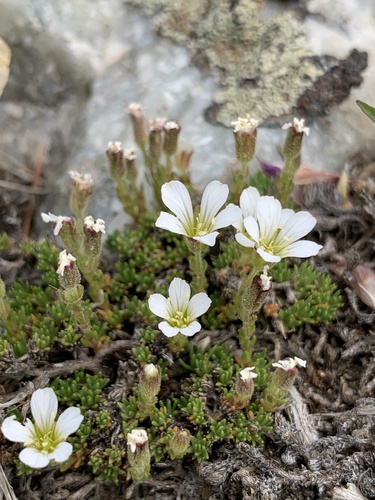


Alpine Sandwort
cherleria obtusiloba
Alpine Sandwort (Cherleria obtusiloba) is a resilient, low-growing perennial plant that thrives in some of the harshest environments on Earth. Sprouting in dense, moss-like cushions, this remarkable alpine specialist hugs the ground to escape the punishing winds and freezing temperatures of high-altitude mountain peaks. During its short summer blooming window, these green mats transform into a beautiful spectacle, blanketed in tiny, star-shaped white flowers. Its compact, dome-shaped cushions act as natural heat-trappers, allowing the plant to photosynthesize efficiently even when surrounded by snow patches. Highly valued as a 'nurse plant,' Alpine Sandwort creates a microhabitat that accumulates organic matter and traps moisture, paving the way for other less hardy alpine species to colonize barren rocky terrain.
生息地: Typically found in dry, exposed alpine tundra, gravelly ridges, fellfields, and rocky slopes at or above the treeline.
This species is easily recognized by its dense, mat-forming cushion growth habit, which closely resembles a clump of moss. It features tiny, tightly packed, needle-like green leaves that are slightly hairy and sharp-tipped, measuring only about 5 to 10 millimeters long. During the mid-summer flowering season, the foliage is adorned with small, five-petaled flowers that range from creamy white to pale yellow. Each flower, approximately 6 to 10 millimeters in diameter, sits on a short, hairy stalk just above the foliage, displaying prominent orange or yellow anthers at its center.
カテゴリ
植物レア度
Common
危険度
1/5 · 非常に低い
スナップ
最初にスナップしよう!
Alpine Sandwort cushions can survive for over a century, growing only a few millimeters in diameter each year in their harsh mountain homes.
Despite looking like soft moss, its needle-like leaves form extremely tough, rigid cushions that can withstand freezing winds and light trampling.
The dense interior of the cushion traps dead leaves and debris, creating a self-fertilizing compost pile that nourishes the plant's own roots.
The dense, low-to-the-ground dome shape reduces wind exposure, limits water loss, and traps warm air within the foliage.
A sturdy, elongated woody taproot anchors the plant securely in loose talus and reaches deep water sources amidst dry rocky soil.
The plant acts like a solar collector, maintaining internal temperatures up to 15 degrees Celsius warmer than the ambient alpine air.
As a photoautotroph, the Alpine Sandwort synthesizes its own organic compounds from carbon dioxide and water using sunlight energy.
Bombus polaris
Pollinated by alpine bees seeking nectar and pollen in extreme environments.
Ochotona princeps
Harvested by pikas and stored in high-altitude haypiles for winter food.
Silene acaulis
Competes for limited rocky soil space and nutrients on exposed alpine ridges.
このオブジェクトにはまだ特徴バッジが割り当てられていません。
まだ別名はありません。
テーマが追加されると、このオブジェクトのコレクションがここに表示されます。
危険度
1/5 · 非常に低い
まだ特別な安全上の注意はありません。
Alpine Sandwortを識別する最も簡単な方法は、Snappit自然識別アプリを使用することです。
3-10 cm
0.02-0.15 kg
20-100 年
As a photoautotroph, the Alpine Sandwort synthesizes its own organic compounds from carbon dioxide and water using sunlight energy.
Typically found in dry, exposed alpine tundra, gravelly ridges, fellfields, and rocky slopes at or above the treeline.
ズームインしてクラスターを分割し、このオブジェクトが撮影された場所を探索しましょう。
新しい観察が追加されると、ここに最近のスナップが表示されます。




.jpg&width=800)







