

American Cranberry
vaccinium macrocarpon
The American Cranberry (Vaccinium macrocarpon) is a resilient, low-growing evergreen dwarf shrub native to the acidic peat bogs and wet sand acidic wetlands of eastern North America. Renowned for its tart, vibrant red berries, this plant plays a significant role in both indigenous traditions and modern agricultural industries. Rather than growing tall, it forms creeping mats of woody stems that hug the damp ground, spreading slowly through underground runners. In addition to its ecological value as a food source for wetland fauna, the American Cranberry is a cultural icon. It represents one of the few commercially cultivated fruits native to North America, celebrated globally during autumn harvest seasons. Its ability to thrive in nutrient-poor, waterlogged soils showcases its remarkable evolutionary adaptations.
生息地: Found in acidic bogs, peatlands, and wet, sandy marshes across eastern North America.
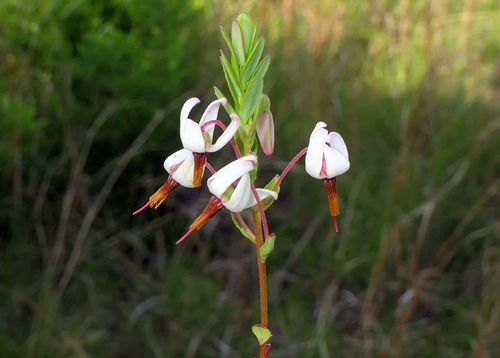
The American Cranberry is characterized by slender, creeping woody vines that grow up to 2 meters long but rise only 5 to 20 centimeters off the ground. Its small, oblong, leathery evergreen leaves are dark green during the growing season and turn a rich bronze-purple color in the winter. During late spring, the plant produces delicate, nodding, light pinkish-white flowers with recurved petals resembling a crane's head. These are followed by spherical or pear-shaped green berries that ripen into a glossy, deep crimson red, measuring about 9 to 20 millimeters in diameter.
カテゴリ
植物レア度
Common
危険度
1/5 · 非常に低い
スナップ
最初にスナップしよう!
Cranberries do not grow directly in water; they grow on dry land in acidic bogs that are intentionally flooded during harvest season so the berries float to the surface.
Some commercial cranberry vines are over a hundred years old and still produce healthy fruit every year.
The name 'cranberry' is derived from the German-Dutch word 'craneberry' because the pink blossoms resembled the head, neck, and bill of a crane.
Each mature cranberry fruit contains four small air pockets that allow it to float, aiding in water-based seed dispersal and facilitating efficient wet-harvesting.
The plant partners with specialized ericoid mycorrhizal fungi in its root system, allowing it to absorb nutrients in highly acidic, oxygen-poor soils.
The leaves feature a thick, waxy cuticle and alter their pigmentation to a bronze hue in winter, protecting the plant from cold damage and desiccation.
As a photosynthetic plant, the American Cranberry produces its own organic sugars using sunlight, water, and carbon dioxide, while absorbing essential minerals through its acidic soil roots.
Bombus impatiens
The Common Bumblebee is a crucial pollinator of cranberry flowers, vibrating the blossoms to release pollen.
Ursus americanus
Black Bears forage heavily on ripe cranberry fruits in the autumn to build up fat reserves for winter.
Odocoileus virginianus
White-tailed deer browse on the evergreen foliage and tender woody stems of the cranberry vine.
このオブジェクトにはまだ特徴バッジが割り当てられていません。
まだ別名はありません。
テーマが追加されると、このオブジェクトのコレクションがここに表示されます。
危険度
1/5 · 非常に低い
まだ特別な安全上の注意はありません。
American Cranberryを識別する最も簡単な方法は、Snappit自然識別アプリを使用することです。
5-20 cm
50-150 年
As a photosynthetic plant, the American Cranberry produces its own organic sugars using sunlight, water, and carbon dioxide, while absorbing essential minerals through its acidic soil roots.
Found in acidic bogs, peatlands, and wet, sandy marshes across eastern North America.
ズームインしてクラスターを分割し、このオブジェクトが撮影された場所を探索しましょう。
新しい観察が追加されると、ここに最近のスナップが表示されます。

Wisconsin, US
ここで見られるかも パープルピッチャープラント, Papillose Peatmoss と タマラック.
ガイドを見る →

New York, US
ここで見られるかも カルミア, シープ・ローレル と ペーリーエバーラスティング.
ガイドを見る →

Ohio, US
ここで見られるかも ドットテイルドホワイトフェイス, コモンホワイトテイル と パープルピッチャープラント.
ガイドを見る →