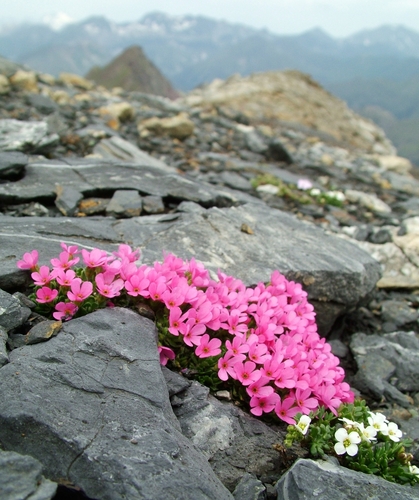


Androsace Ciliata
androsace ciliata
Androsace ciliata, commonly known as the Ciliate Rock-jasmine, is a resilient and enchanting alpine perennial endemic to the high-altitude rocky landscapes of the Pyrenees. This remarkable plant thrives in the most challenging environments, clinging to sheer cliffs, unstable scree slopes, and windswept crevices where few other species can survive. By forming compact, low-growing cushions, it creates its own microclimate to withstand freezing temperatures, intense ultraviolet radiation, and dry alpine winds.
生息地: Found in high-altitude rocky crevices, limestone screes, and alpine ridges of the Pyrenees mountain range.
This plant forms dense, dome-like cushions or loose mats of tiny, bright green leaf rosettes, typically reaching only 2 to 10 centimeters in height. Its small, lanceolate leaves are highly distinct for their 'ciliated' margins, which are fringed with fine, eyelash-like white hairs. During its brief spring and summer blooming period, the green cushion is beautifully dotted with solitary, five-petaled flowers that open in shades of soft pink to deep purplish-pink, each featuring a tiny, contrasting yellow-to-orange eye at the center.
カテゴリ
植物レア度
Common
危険度
1/5 · 非常に低い
スナップ
最初にスナップしよう!
Because of the extremely short growing season in the high Pyrenees, a cushion the size of a teacup can easily be several decades old.
It is a strict Pyrenean endemic, meaning this delicate pink wildflower cannot be found growing naturally anywhere else on Earth.
Its species name 'ciliata' comes from the Latin word for eyelashes, describing the fringe of hairs on its tiny leaves.
Forms compact, tightly packed domes that trap warm air and retain precious moisture, protecting the plant from freezing alpine temperatures and high winds.
Possesses fine, specialized hairs along its leaf margins that break up desiccating winds, trap humidity, and reduce water loss.
Produces specialized protective pigments to prevent cellular damage from intense, unfiltered solar radiation at high elevations.
As a photoautotroph, this alpine plant produces its own energy by performing photosynthesis, utilizing sunlight, carbon dioxide, and minimal water and nutrients absorbed from barren rock fissures.
Bombus pyrenaeus
Pollinated by alpine insects seeking nectar in the harsh mountain environment.
Saxifraga oppositifolia
Competes for limited soil pockets and moisture on sheer rock faces.
Rupicapra pyrenaica
Occasional grazing of foliage by high-altitude herbivores.
このオブジェクトにはまだ特徴バッジが割り当てられていません。
まだ別名はありません。
テーマが追加されると、このオブジェクトのコレクションがここに表示されます。
危険度
1/5 · 非常に低い
まだ特別な安全上の注意はありません。
Androsace Ciliataを識別する最も簡単な方法は、Snappit自然識別アプリを使用することです。
2+ cm
0.01+ kg
As a photoautotroph, this alpine plant produces its own energy by performing photosynthesis, utilizing sunlight, carbon dioxide, and minimal water and nutrients absorbed from barren rock fissures.
Found in high-altitude rocky crevices, limestone screes, and alpine ridges of the Pyrenees mountain range.
Photosynthesis
ズームインしてクラスターを分割し、このオブジェクトが撮影された場所を探索しましょう。
新しい観察が追加されると、ここに最近のスナップが表示されます。














