

Armoracia
armoracia
Armoracia, commonly known as horseradish, is a vigorous, leafy perennial plant renowned worldwide for its intensely pungent, thick taproot. Native to southeastern Europe and western Asia, this hardy member of the mustard family has been cultivated for thousands of years as both a culinary spice and a traditional herbal medicine. Its large, dark green leaves rise in robust clumps, presenting a striking presence in gardens and wild landscapes alike. When its root is grated, a chemical reaction releases volatile compounds that clear the sinuses and excite the palate. Beyond its famous root, the plant plays a valuable role in temperate ecosystems, offering nectar to early-season pollinators and demonstrating an astonishing ability to thrive in poor, disturbed soils.
生息地: Typically found in damp, nutrient-rich soils along roadsides, riparian zones, abandoned agricultural fields, and disturbed ground.
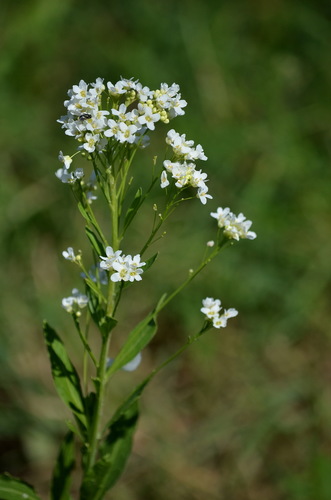
This plant is characterized by large, oblong, crinkled green leaves with wavy edges that grow in dense basal rosettes, reaching up to 150 centimeters in height. In late spring, it sends up tall, branched flower stalks bearing delicate clusters of tiny, four-petaled white flowers. Beneath the surface lies its defining feature: a long, tapered, cylindrical taproot with a rough, tan-beige exterior and a crisp, pure white interior flesh.
カテゴリ
植物レア度
Common
危険度
1/5 · 非常に低い
スナップ
最初にスナップしよう!
In traditional European medicine, the root was used as a plaster to relieve joint pain and respiratory congestion.
Nearly all commercially sold wasabi paste in Western restaurants is actually dyed horseradish mixed with mustard.
The burning sensation of horseradish is not experienced on the tongue but in the nasal passages, caused by volatile mustard oils.
Synthesizes glucosinolates that convert to pungent allyl isothiocyanate when plant tissue is crushed, deterring most herbivores.
Can regenerate an entirely new plant from a tiny fragment of root left deep in the soil, making it highly resilient.
Withstands freezing winter temperatures by entering dormancy, protecting its deep root system to sprout vigorously in spring.
As a photosynthetic autotroph, it produces its own energy using sunlight, carbon dioxide, and water while absorbing soil nutrients.
Pieris rapae
Caterpillars feed heavily on the large, nutrient-rich leaves.
Phyllotreta armoraciae
An insect specialist that feeds exclusively on plants of the Brassicaceae family, including horseradish leaves.
Apis mellifera
Attracted to the dense panicles of small white flowers for pollen and nectar collection.
このオブジェクトにはまだ特徴バッジが割り当てられていません。
まだ別名はありません。
テーマが追加されると、このオブジェクトのコレクションがここに表示されます。
危険度
1/5 · 非常に低い
まだ特別な安全上の注意はありません。
Armoraciaを識別する最も簡単な方法は、Snappit自然識別アプリを使用することです。
60-150 cm
0.5-3 kg
5-20 年
As a photosynthetic autotroph, it produces its own energy using sunlight, carbon dioxide, and water while absorbing soil nutrients.
Typically found in damp, nutrient-rich soils along roadsides, riparian zones, abandoned agricultural fields, and disturbed ground.
ズームインしてクラスターを分割し、このオブジェクトが撮影された場所を探索しましょう。
新しい観察が追加されると、ここに最近のスナップが表示されます。