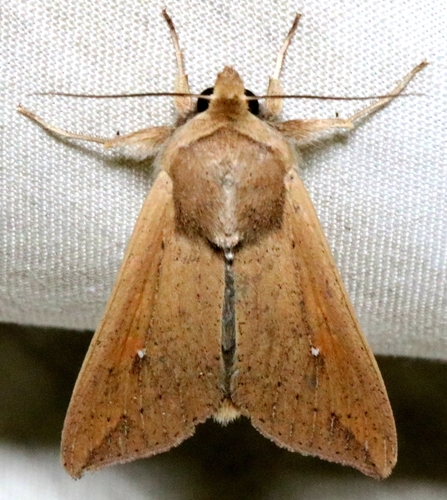


Armyworm Moth
pseudaletia unipuncta
The Armyworm Moth (Pseudaletia unipuncta), also known as the True Armyworm, is a widespread nocturnal moth best known for the destructive habits of its caterpillars. While the adult moth is a modest, nectar-sipping pollinator, its larval stage is a formidable force in the agricultural world. When populations explode, the caterpillars gather in massive, marching armies, systematically consuming vast fields of grasses, grains, and crops before moving on to the next food source. This incredible swarming behavior is both a marvel of collective movement and a serious challenge for farmers globally. Beyond their agricultural impact, Armyworm Moths play a vital role in local food webs, serving as a bountiful food source for birds, bats, and predatory insects. They are a classic example of nature's boom-and-bust population cycles, intricately tied to weather patterns and seasonal changes.
生息地: Primarily found in open, grassy environments such as agricultural fields, pastures, meadows, and lawns, particularly where cereal crops or turf grasses are abundant.
The adult Armyworm Moth is relatively unassuming, characterized by a wingspan of about 3 to 5 centimeters and pale brown to grayish-tan forewings. Its most distinctive visual identifier is a single, small, bright white spot located near the center of each forewing, which gives the species its scientific name, unipuncta. The hindwings are generally lighter, with a grayish-white hue and darker veins. The caterpillars, which are more frequently encountered by humans, are mostly hairless and vary in color from greenish-brown to nearly black, featuring distinct longitudinal stripes of orange, white, and dark brown running down the length of their bodies.
カテゴリ
昆虫レア度
Common
危険度
1/5 · 非常に低い
スナップ
最初にスナップしよう!
During severe outbreaks, armyworm caterpillars can completely decimate entire fields of crops or residential lawns in just a matter of days.
The name armyworm describes the caterpillars' tendency to march together in massive lines across the ground to find new food when they have stripped a field bare.
The specific epithet unipuncta translates to one spot, referring to the single distinct white dot found in the center of each of the adult moth's forewings.
While the caterpillars are infamous agricultural pests, the adult moths are actually beneficial nocturnal pollinators that feed on nectar.
Larvae aggregate and move synchronously in massive, army-like formations to find new food sources when local vegetation is depleted.
Adults possess excellent nocturnal vision and sensory adaptations, allowing them to navigate, mate, and forage for nectar under the cover of darkness.
Females can lay over a thousand eggs in a matter of days, enabling explosive population growth under favorable environmental conditions.
Larvae are voracious herbivores that heavily consume grasses and grains, while adults feed on liquid nectar from various flowers.
年齢による違い: Larvae strictly chew and consume plant foliage, whereas adults use a proboscis to sip floral nectar.
Turdus migratorius
Preys heavily on armyworm caterpillars during large outbreaks.
Cotesia marginiventris
Lays eggs inside armyworm caterpillars, naturally controlling their populations.
Zea mays
A major food source and host plant for developing armyworm larvae.
このオブジェクトにはまだ特徴バッジが割り当てられていません。
まだ別名はありません。
テーマが追加されると、このオブジェクトのコレクションがここに表示されます。
危険度
1/5 · 非常に低い
まだ特別な安全上の注意はありません。
Armyworm Mothを識別する最も簡単な方法は、Snappit自然識別アプリを使用することです。
2-4 cm
3-5 cm
0.0001-0.0005 kg
0-1 年
Larvae are voracious herbivores that heavily consume grasses and grains, while adults feed on liquid nectar from various flowers.
Primarily found in open, grassy environments such as agricultural fields, pastures, meadows, and lawns, particularly where cereal crops or turf grasses are abundant.
Foraging
ズームインしてクラスターを分割し、このオブジェクトが撮影された場所を探索しましょう。
新しい観察が追加されると、ここに最近のスナップが表示されます。









