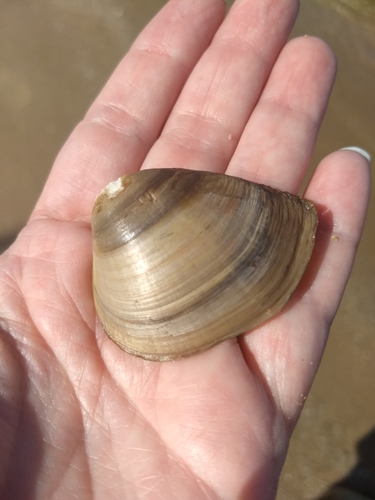


Atlantic Rangia
rangia cuneata
The Atlantic Rangia (Rangia cuneata) is a remarkable, heavy-shelled bivalve that thrives in environments where most other marine life struggles. Native to the Gulf of Mexico, this unassuming clam has mastered the art of living in brackish waters—estuaries where rivers meet the sea, creating wildly fluctuating salinity levels. Over the decades, it has steadily expanded its range, colonizing the Atlantic coast of North America and even invading European waterways via the ballast water of commercial ships. What makes the Atlantic Rangia truly fascinating is its role as both an ecosystem engineer and a resilient survivor. By constantly filtering water, it plays a vital role in cleaning estuaries, removing suspended particles, and cycling nutrients back into the food web. Its robust, wedge-shaped shell offers exceptional protection against both predators and drastic environmental changes, allowing it to seal itself off during extreme low-salinity events. Whether acting as a crucial food source for coastal wildlife or adapting to new habitats across the globe, the Atlantic Rangia is a testament to the adaptability of estuarine organisms.
生息地: Found primarily buried in the sandy or muddy bottoms of brackish estuaries, coastal bays, and river mouths with low salinity.
The Atlantic Rangia features a thick, heavy, and distinctively wedge-shaped (cuneate) shell that typically grows to about 4 to 6 centimeters in length. The exterior is covered by a pale brown, grayish, or nearly black periostracum (a protective outer skin) that often peels away near the prominent, forward-pointing beaks (umbones) at the top of the shell. The shell's anterior end is broadly rounded, while the posterior end tapers to a blunt point. Inside, the shell is usually a dull, chalky white with a deep pallial sinus. Unlike some brightly colored marine bivalves, its muted, muddy tones act as excellent camouflage against the sandy or muddy estuarine bottoms where it burrows.
カテゴリ
Invertebrateレア度
Common
危険度
1/5 · 非常に低い
スナップ
最初にスナップしよう!
Because they build such thick, sturdy shells, empty Rangia shells are commonly dredged, harvested, and used as aggregate roadbed material in coastal Louisiana and Texas.
Despite being an aquatic animal, it requires a very specific 'salinity shock'—a sudden drop or spike in water salt levels—to trigger its reproductive spawning process.
It hitchhiked across the Atlantic Ocean in the ballast water of cargo ships, easily surviving the dark, oxygen-poor voyage to establish thriving populations in European harbors.
The Atlantic Rangia was once a major food source for Native American tribes along the Gulf Coast, evidenced by massive, ancient shell middens left behind.
The Atlantic Rangia is a master of osmoregulation, capable of surviving and thriving in rapidly changing brackish environments ranging from near-freshwater to moderate marine salinities.
It can survive prolonged periods of low oxygen levels in the water by slowing its metabolism and closing its thick shell tightly to isolate itself from poor water conditions.
As a highly efficient filter feeder, it actively draws in surrounding water to capture plankton and detritus, significantly improving water clarity in turbid estuaries.
The Atlantic Rangia is an active filter feeder that draws in water through its siphons to extract suspended microscopic organisms and organic matter.
年齢による違い: Planktonic larvae rely entirely on microscopic phytoplankton, while settled adults filter larger suspended particulate matter and detritus from the water column.
Callinectes sapidus
Consumes this clam by crushing its heavy shell with powerful claws.
Aythya affinis
Forages for these clams by diving in shallow estuarine waters.
Pogonias cromis
Preys heavily on Rangia clams using its specialized, powerful crushing jaw teeth.
Dreissena polymorpha
Competes for space and food resources in invaded European brackish ecosystems.
このオブジェクトにはまだ特徴バッジが割り当てられていません。
まだ別名はありません。
テーマが追加されると、このオブジェクトのコレクションがここに表示されます。
危険度
1/5 · 非常に低い
まだ特別な安全上の注意はありません。
Atlantic Rangiaを識別する最も簡単な方法は、Snappit自然識別アプリを使用することです。
3-7 cm
0.01-0.05 kg
8-15 年
The Atlantic Rangia is an active filter feeder that draws in water through its siphons to extract suspended microscopic organisms and organic matter.
Found primarily buried in the sandy or muddy bottoms of brackish estuaries, coastal bays, and river mouths with low salinity.
Filtering
10000-50000
ズームインしてクラスターを分割し、このオブジェクトが撮影された場所を探索しましょう。
新しい観察が追加されると、ここに最近のスナップが表示されます。

















.jpg&width=800)

