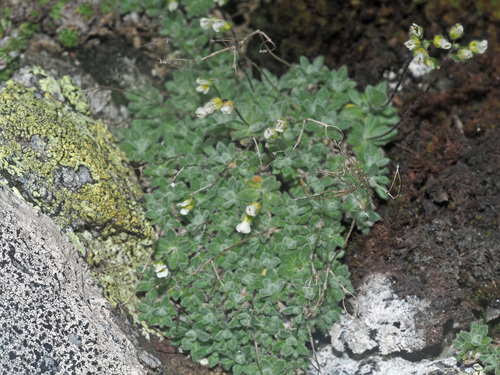


Austrian Whitlow-Grass
draba dubia
The Austrian Whitlow-Grass (Draba dubia) is a resilient, low-growing alpine perennial that thrives where few other plants dare to venture. Clinging to rocky crevices, scree slopes, and windswept mountain ridges across Europe's high-altitude ranges, this diminutive member of the mustard family showcases the incredible endurance of alpine flora. Despite the harsh climates, it bursts into delicate blooms during the brief alpine summer, providing crucial resources for high-altitude pollinators. Adapted to freezing temperatures, intense UV radiation, and nutrient-poor soils, Austrian Whitlow-Grass forms compact, ground-hugging cushions or rosettes. This growth form protects it from biting mountain winds and helps trap heat close to the ground, demonstrating how miniature scale can be an evolutionary superpower in extreme environments.
生息地: Found primarily in rocky subalpine and alpine zones, colonizing limestone crevices, gravelly scree, and windswept mountain ridges.
This petite perennial typically reaches heights of only 5 to 15 centimeters, forming a neat basal rosette of grayish-green, spoon-shaped leaves. These leaves are covered in a dense coat of fine, star-shaped (stellate) hairs, giving the foliage a slightly frosty or woolly appearance that helps retain moisture. During late spring and summer, slender, leafless stems arise from the rosette, topped by small clusters of four-petaled white flowers. Following pollination, the plant develops distinctive, flattened, lance-shaped seed pods called siliques, which twist slightly as they mature.
カテゴリ
植物レア度
Common
危険度
1/5 · 非常に低い
スナップ
最初にスナップしよう!
Despite its fragile appearance, this plant can survive temperatures far below freezing even during its active flowering phase.
Its seeds are adapted to be dispersed by mountain winds, but also by water washing down steep alpine slopes.
The common name Whitlow-Grass comes from a traditional herbal belief that species in the Draba genus could cure whitlows, which are painful infections of the fingernail.
Dense, star-shaped hairs on its leaves trap a boundary layer of air to reduce water loss from wind and reflect harsh high-altitude UV radiation.
Accumulates soluble sugars and protective proteins in its cells to prevent ice crystal damage during sudden mountain frosts.
Features a strong, penetrating taproot system capable of anchoring securely in tiny rock crevices to extract scarce moisture and nutrients.
As a photoautotroph, the Austrian Whitlow-Grass produces its own energy through photosynthesis, utilizing sunlight, carbon dioxide, and soil minerals.
Bombus alpinus
Pollinated by alpine insects seeking nectar in the early summer.
Rupicapra rupicapra
Foraged upon by high-altitude grazing herbivores.
Pontia callidice
Larvae feed on the leaves of various alpine brassicas.
このオブジェクトにはまだ特徴バッジが割り当てられていません。
まだ別名はありません。
テーマが追加されると、このオブジェクトのコレクションがここに表示されます。
危険度
1/5 · 非常に低い
まだ特別な安全上の注意はありません。
Austrian Whitlow-Grassを識別する最も簡単な方法は、Snappit自然識別アプリを使用することです。
5-15 cm
3-10 年
As a photoautotroph, the Austrian Whitlow-Grass produces its own energy through photosynthesis, utilizing sunlight, carbon dioxide, and soil minerals.
Found primarily in rocky subalpine and alpine zones, colonizing limestone crevices, gravelly scree, and windswept mountain ridges.
Photosynthesis
ズームインしてクラスターを分割し、このオブジェクトが撮影された場所を探索しましょう。
新しい観察が追加されると、ここに最近のスナップが表示されます。
















