

Baker Kingcup Cactus
echinocereus bakeri
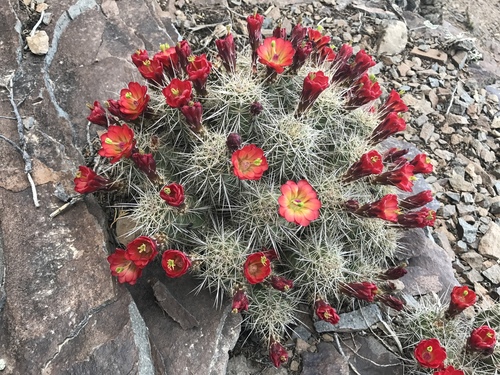
The Baker Kingcup Cactus, scientifically known as Echinocereus bakeri, is a spectacular succulent native to the arid rocky slopes of the southwestern United States. Forming dense, multi-stemmed mounds, this resilient cactus is highly celebrated for its spectacular spring display. During the blooming season, it erupts with brilliant, cup-shaped scarlet flowers that stand in sharp contrast to the harsh, dusty desert floor. These showy blooms are not just a visual treat; they act as a crucial early-season nectar source for returning hummingbirds and native bees. Adapted to thrive in nutrient-poor soils and under intense sunlight, this species showcases the incredible resourcefulness of desert flora. Gardeners and nature enthusiasts cherish the Baker Kingcup Cactus for its rugged beauty, extreme frost tolerance, and ability to thrive where few other plants can survive.
生息地: Typically found growing on rocky limestone slopes, gravelly ledges, and sandstone canyon walls in desert scrublands.
This cactus grows in dense, cushion-like clumps consisting of several dozen cylindrical, pale green to bluish-green stems. Each stem stands upright, reaching up to 40 centimeters in height, and is marked by 8 to 11 pronounced ribs. These ribs are adorned with clusters of needle-like spines, with yellowish-brown central spines and paler radial spines spreading outward. In late spring, the plant produces magnificent funnelform, cup-shaped flowers that are vibrant orange-red to deep scarlet, measuring up to 8 centimeters across. The flowers feature bright green stigma lobes at their centers, surrounded by numerous pollen-dusted stamens.
カテゴリ
植物レア度
Common
危険度
1/5 · 非常に低い
スナップ
最初にスナップしよう!
Its flowers remain open both day and night for several days, unlike many other desert cacti whose blooms only last a single day.
Native Americans historically used the boiled stems of related Echinocereus species as a traditional sweet treat or for medicinal heart remedies.
The common name 'Kingcup' refers to the bright, chalice-like shape of its brilliant red flowers.
Utilizes Crassulacean Acid Metabolism to open its stomata only at night, significantly reducing water loss during the heat of the day.
Withstands freezing winter temperatures down to -15 degrees Celsius by actively dehydrating its cells to prevent ice crystal damage.
Forms dense, multi-headed mounds that shade their own bases and collect moisture, creating a self-sustaining microclimate.
As a photosynthetic plant, it synthesizes its own sugars from sunlight, water, and carbon dioxide, while absorbing essential minerals through its shallow root system.
Archilochus alexandri
Pollinates the flowers while feeding on nectar.
Neotoma lepida
Feeds on the cactus stems and fruits, occasionally using the spiny mounds for nesting shelter.
Lasioglossum pectoraloides
Collects pollen from the flowers, assisting in cross-pollination.
このオブジェクトにはまだ特徴バッジが割り当てられていません。
まだ別名はありません。
テーマが追加されると、このオブジェクトのコレクションがここに表示されます。
危険度
1/5 · 非常に低い
まだ特別な安全上の注意はありません。
Baker Kingcup Cactusを識別する最も簡単な方法は、Snappit自然識別アプリを使用することです。
10-40 cm
0.5-6 kg
20-60 年
As a photosynthetic plant, it synthesizes its own sugars from sunlight, water, and carbon dioxide, while absorbing essential minerals through its shallow root system.
Typically found growing on rocky limestone slopes, gravelly ledges, and sandstone canyon walls in desert scrublands.
ズームインしてクラスターを分割し、このオブジェクトが撮影された場所を探索しましょう。
新しい観察が追加されると、ここに最近のスナップが表示されます。











